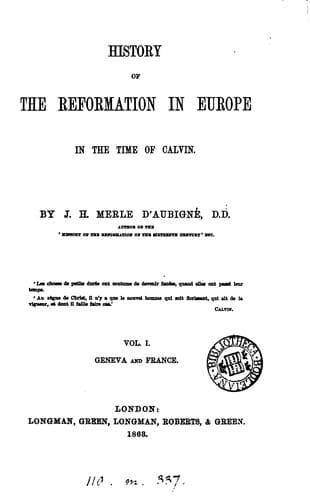
History of the Reformation in Europe in the Time of Calvin, Vol. 8 (of 8)Merle d'Aubigné, J. H. (Jean Henri)
History
History of the Reformation in Europe in the Time of Calvin, Vol. 8 (of 8)
Merle d'Aubigné, J. H. (Jean Henri)
Reformation
grammar and history; but, being fond of travelling, he resided some
time at Constantinople, and acquired much wealth by dyeing cloth made
in Italy, which was transported thither and committed to his care, on
account of the abundance of alum in that neighborhood. Having by these
means an opportunity of seeing daily the manner in which alum was made,
and from what stones or earth it was extracted, he soon learned the
art. When, by the will of God, that city was taken and plundered about
the year 1453, by Mahomet II., Emperor of the Turks, he lost his whole
property; but, happy to have escaped the fire and sword of these cruel
people, he returned to Italy, after the assumption of Pius II., to whom
he was related, and from whom he obtained, as an indemnification for
his losses, the office of Commissary-General over all the revenues of
the Apostolic Chamber, both within and without the city. While in this
situation he was traversing all the hills and mountains, searching
the bowels of the earth, leaving no stone or clod unexplored, he at
length found some alum-stone in the neighborhood of Tolfa. Old Tolfa
is a town belonging to two brothers, subjects of the Church of Rome,
and situated at a small distance from Civita Vecchia. Here there are
high mountains, retiring inland from the sea, which abound with wood
and water. While Castro was examining these, he observed that the grass
had a new appearance. Being struck with wonder, and inquiring into the
cause, he found that the mountains of Asia, which enrich the Turkish
treasury by their alum, were covered with grass of the like kind.
Perceiving several white stones, which seemed to be minerals, he bit
some of them, and found that they had a saltish taste. This induced him
to make some experiments by calcining them, and he at length obtained
alum. He repaired therefore to the Pontiff, and addressing him said,
"I announce to you a victory over the Turk. He draws yearly from the
Christians above three hundred thousand pieces of gold, paid to him
for the alum with which we dye wool different colors, because none
is found here but a little at the island of Hiscla, formerly called
Aenaria, near Puteoli, and in the cave of Vulcan at Lipari, which,
being formerly exhausted by the Romans, is now almost destitute of that
substance. I have, however, found seven hills so abundant in it, that
they would be almost sufficient to supply seven worlds. If you will
send for workmen, and cause furnaces to be constructed, and the stones
to be calcined, you may furnish alum to all Europe; and that gain
which the Turk used to acquire by this article being thrown into your
hands will be to him a double loss. Wood and water are both plenty,
and you have in the neighborhood the port of Civita Vecchia, where
vessels bound to the West may be loaded. You can now make war against
the Turk: this mineral will supply you with the sinews of war, that is
money, and at the same time deprive the Turk of them." These words of
Public-domain text, read in full here on John Shaqi.
Reviews
Reviews
No reviews yet
Be the first to share your thoughts on this work.
Elsewhere in the archive
Join the Discussion
Join the discussion
Sign in to leave a comment or review.
Sign InorCreate an account