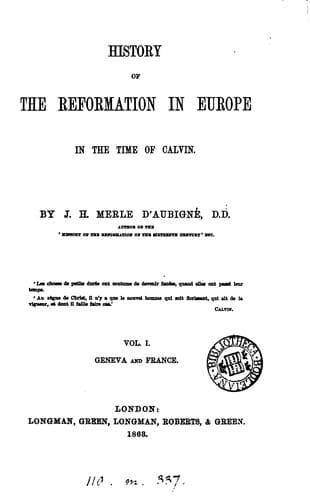
History of the Reformation in Europe in the Time of Calvin, Vol. 8 (of 8)Merle d'Aubigné, J. H. (Jean Henri)
History
History of the Reformation in Europe in the Time of Calvin, Vol. 8 (of 8)
Merle d'Aubigné, J. H. (Jean Henri)
Reformation
Castro appeared to the Pontiff the ravings of a madman: he considered
them as mere dreams, like the predictions of astrologers; and all
the cardinals were of the same opinion. Castro, however, though his
proposals were often rejected, did not abandon his project, but applied
to his Holiness by various persons, in order that experiments might be
made in his presence on the stones which he had discovered. The Pontiff
employed skilful people, who proved that they really contained alum;
but lest some deception might have been practised, others were sent to
the place where they had been found, who met with abundance of the like
kind. Artists who had been employed in the Turkish mines in Asia were
brought from Genoa; and these, having closely examined the nature of
the place, declared it to be similar to that of the Asiatic mountains
which produce alum; and, shedding tears for joy, they kneeled down
three times, worshipping God, and praising his kindness in conferring
so valuable a gift on our age. The stones were calcined, and produced
alum more beautiful than that of Asia, and superior in quality. Some
of it was sent to Venice and to Florence, and, being tried, was found
to answer beyond expectation. The Genoese first purchased a quantity
of it, to the amount of 20,000 pieces of gold; and Cosmo of Medici for
this article laid out afterwards seventy-five thousand. On account
of this service, Pius thought Castro worthy of the highest honors
and of a statue, which was erected to him in his own country, with
this inscription:--"To John di Castro, the Inventor of Alum;" and he
received besides a certain share of the profit. Immunities and a share
also of the gain were granted to the two brothers, lords of Tolfa, in
whose land the aluminous mineral had been found. This accession of
wealth to the Church of Rome was made, by the divine blessing, under
the Pontificate of Pius II.: and if it escape, as it ought, the hands
of tyrants, and be prudently managed, it may increase and afford no
small assistance to the Roman Pontiffs in supporting the burdens of
the Christian religion--_Pii Secundi Comment . rer . memorab . quæ
temp . suis contigerunt. Francof._ 1614, _fol. p._ 185'
Dr. Georg Voigt, in his 'Enea Silvio de Piccolomini als Papst Pius der
Zweite und sein Zeitalter,' vol. iii. pp. 546-48, says:--
Public-domain text, read in full here on John Shaqi.
Reviews
Reviews
No reviews yet
Be the first to share your thoughts on this work.
Elsewhere in the archive
Join the Discussion
Join the discussion
Sign in to leave a comment or review.
Sign InorCreate an account