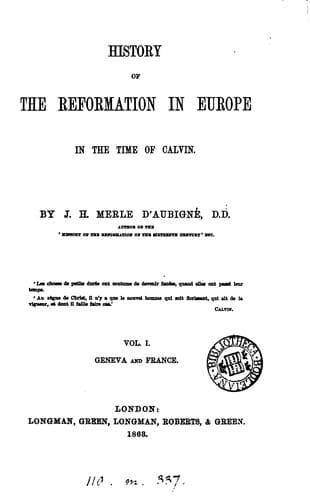
History of the Reformation in Europe in the Time of Calvin, Vol. 8 (of 8) — John Shaqi
History of the Reformation in Europe in the Time of Calvin, Vol. 8 (of 8)Merle d'Aubigné, J. H. (Jean Henri)
History
History of the Reformation in Europe in the Time of Calvin, Vol. 8 (of 8)
Merle d'Aubigné, J. H. (Jean Henri)
Reformation
Holy Scriptures, prayed, meditated, and read good authors; and thus
made progress in the knowledge of true theology.
Rodrigo de Valerio was made glad by the wonderful change which God had
wrought through his ministry; and the victory which he had won raised
still higher his burning zeal. He began to proclaim the Gospel not only
in private meetings, but in public, in the streets and squares of the
town, near the Giralda, the convent of Buena Vitta, the Alcazar, and
on the banks of the Guadalquivir. He was denounced to the holy office,
and when he appeared before the tribunal of the Inquisition he spoke
earnestly about the real church of Christ, set forth its distinguishing
marks, and especially insisted on the justification of man by faith.
This took place a little while after the conversion of Egidius, whose
new faith was not yet known, and who still enjoyed in society the
reputation of a scholar and a good Catholic. Glad of an opportunity
of repaying his great debt, he came before the tribunal and defended
his friend. He thus exerted an influence over the judges, and they
took into consideration the lowliness of Valerio's family and the rank
which he held in society. Moreover, they said Valerio is tainted with
insanity, and it can hardly be necessary to hand over a madman to the
secular power. His goods were confiscated, he was exhorted to return
to the right path, and was then set at liberty.
The astonishing change which had been effected in Egidius was soon
remarked at Seville. Now fully persuaded of the need of repentance
and faith, and possessing salvation by personal experience,[49] his
preaching was henceforth as simple, affectionate, and fervent as it had
before been cold, ignorant, and pedantic. Abstract propositions and
fruitless disputations now gave place to powerful appeals to conscience
and to entreaties full of charity. General attention was aroused. Once
more a multitude thronged the noble cathedral, erected on the very
spot on which the Arabs had formerly built a magnificent mosque, in
which neither altar nor image was to be seen, but which was brilliant
with marbles and lamps. The Christians were now summoned to hear the
good news by bells in the summit of the Mohammedan tower, the Giralda,
whence the muezzins had once called the people to prayer. This was the
sole remnant of the mosque, and it gave its name to the church. Jesus
Christ now took the place of the false prophet and the vain forms
of the papacy; and many believed in the grace of the Son of God. In
the discourses of Egidius there was a charm which was felt alike by
the educated and the ignorant. He was the most animated and the most
popular preacher who had ever appeared at Seville; and his history
shows, better perhaps than that of any other preacher, that the first
quality of an orator is a heart burning with love and with fervent
emotion. _Pectus facit oratorem._ This man had received from God the
Public-domain text, read in full here on John Shaqi.
Reviews
Reviews
No reviews yet
Be the first to share your thoughts on this work.
Join the Discussion
Join the discussion
Sign in to leave a comment or review.
Sign InorCreate an account