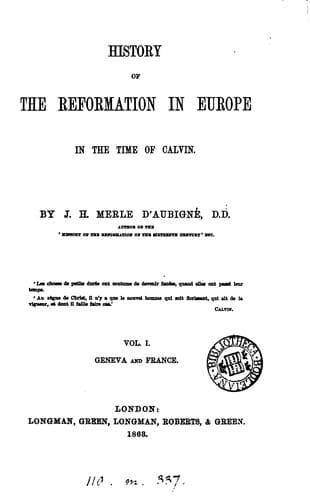
History of the Reformation in Europe in the Time of Calvin, Vol. 8 (of 8)Merle d'Aubigné, J. H. (Jean Henri)
History
History of the Reformation in Europe in the Time of Calvin, Vol. 8 (of 8)
Merle d'Aubigné, J. H. (Jean Henri)
Reformation
excellent gift of penetrating the souls of those who heard him with a
divine fire[50] which animated all their deeds of piety and fitted them
to endure lovingly the cross with which they were threatened. Christ
was with him in his ministry, says one of those who were converted
by him; and this divine Master himself engraved, by the virtue of his
Spirit, the words of his servant on the hearts of his hearers.[51]
Valerio was the layman of the Reformation; Egidius became its minister.
[Sidenote: PONCE DE LA FUENTE AND VARGAS.]
He was not long alone. During his residence at Alcala, three students
were observed to be united in close friendship with each other. These
were John Egidius, Constantine Ponce de la Fuente, and Vargas. Now
these two old fellow-students arrived at Seville. The Castilian,
Constantine Ponce de la Fuente, was born at St. Clement, in the diocese
of Cuença. The inhabitants of these districts concealed under an aspect
of coldness a free and boisterous gaiety. Ponce de la Fuente was
certainly one of these people. He had a caustic humor, was a lover of
pleasure, and ardent in all that he did. His youth had been somewhat
dissipated, and for this he was afterwards reproached by his enemies.
But he possessed also good sense and a moral disposition, which soon
led him to embrace a more regular life, even before he was acquainted
with the Gospel. He never lost, however, his cheerfulness and his wit.
He was animated by a strong desire to gain solid knowledge, and at the
same time he felt great aversion to the pedantry and barbarism of the
schools. In some respects he was like Erasmus. He was a son of the
Renaissance, and, like his master, enjoyed ridiculing the ignorance of
the monks, the fooleries of the preachers, and the hypocrisy of the
pharisees. Although he had not the genius of the great man of letters,
in some points he surpassed him. There was more depth in his faith and
more decision in his character. Contradictory qualities met in his
nature. He would hurl in all directions his satirical darts, and yet he
was full of benevolence and generosity, and was always ready to give
assistance to any one. It was, moreover, said of him that no one ever
loved or hated him moderately. His acquaintance with the human heart,
his knowledge of the egotism and the indifference which are found even
in the best men, made him very scrupulous in the selection of his
friends. But he deeply loved the few to whom he was attached; and with
his great acquirements he combined a free and cordial manner.
Public-domain text, read in full here on John Shaqi.
Reviews
Reviews
No reviews yet
Be the first to share your thoughts on this work.
Join the Discussion
Join the discussion
Sign in to leave a comment or review.
Sign InorCreate an account