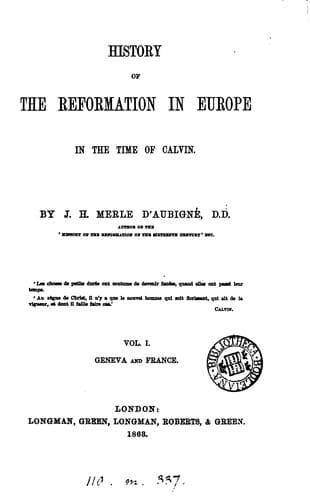
History of the Reformation in Europe in the Time of Calvin, Vol. 8 (of 8) — John Shaqi
History of the Reformation in Europe in the Time of Calvin, Vol. 8 (of 8)Merle d'Aubigné, J. H. (Jean Henri)
History
History of the Reformation in Europe in the Time of Calvin, Vol. 8 (of 8)
Merle d'Aubigné, J. H. (Jean Henri)
Reformation
The reputation of Ponce de la Fuente was ere long as widespread as that
of Egidius. There was one feature in his character which doubled, nay,
which multiplied a hundredfold the force and result of his preaching.
He was free from vanity. This besetting sin of the orator, a vice
which paralyses his influence, had no place in him. He was quite
exempt from that exalted opinion of himself which is so natural to the
human heart, and especially to the public speaker. He had recovered
the first of all loves--the love of God; and this so filled his soul
that it left no room for any other. He was indifferent to the praises
of his hearers, and his only thought was how to win their hearts for
God. His reputation procured him several calls. The chapter of Cuença
unanimously invited him to be preacher at the cathedral. By accepting
the invitation he would have gained an honorable position in his own
province; but he chose rather to remain the curate of Egidius. Some
time afterwards a deputation arrived at Seville, commissioned to
announce to de la Fuente that he was called to succeed the titular
bishop of Utica as preacher at the metropolitan church of Toledo, an
office of high honor and very much sought after.[56] No one doubted
that he would accept a place which was the object of ambition to so
many men. De la Fuente, having no wish to leave Seville, where a great
door was opened to him, declined the offer. The canons persisted in
their application, pressed him and seemed bent on compelling him. In
order to get rid of their importunity, Ponce availed himself of an
objection which was certainly in character with the turn of his mind.
In the church of Toledo a dispute was at this time going on between
several members of the chapter and the cardinalarchbishop John de
Martinez Siliceo, who had decreed that the candidates elected by
the chapter should be bound to prove that they were descended from
blameless ancestors. Now de la Fuente had no reason to fear this rule
more than any other; but being driven to extremities, he replied to the
deputies with an arch smile that 'the bones of his ancestors had rested
in peace for many years, and that he would not disturb their repose.'
[Sidenote: OPPOSITION.]
Public-domain text, read in full here on John Shaqi.
Reviews
Reviews
No reviews yet
Be the first to share your thoughts on this work.
Join the Discussion
Join the discussion
Sign in to leave a comment or review.
Sign InorCreate an account