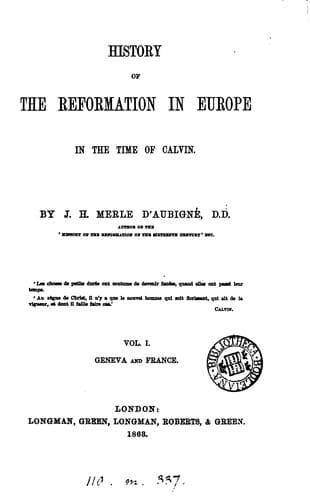
History of the Reformation in Europe in the Time of Calvin, Vol. 8 (of 8) — John Shaqi
History of the Reformation in Europe in the Time of Calvin, Vol. 8 (of 8)Merle d'Aubigné, J. H. (Jean Henri)
History
History of the Reformation in Europe in the Time of Calvin, Vol. 8 (of 8)
Merle d'Aubigné, J. H. (Jean Henri)
Reformation
Ponce de la Fuente, above all, charmed his hearers not only by the
beauty of the doctrine which he proclaimed, but also by the purity
and elegance of his language, and by the overpowering bursts of his
eloquence. Those who heard it exclaimed, 'A miracle!'[60] Ponce was
a great observer, and this both by nature and by choice. He took his
stand as it were upon a height, and set himself to consider attentively
all that presented itself to him--physical phenomena, moral affections,
and human affairs.[61] By means of his learning, his experience, and
his knowledge of the Holy Scriptures, he was able to contemplate as
from an elevated position all things human and divine. He had also an
accurate judgment, a quality of the first importance to a preacher. He
had a sense of the just value of things; discretion not only guided
him in all his actions, but also inspired all his words. This explains
the popularity which he ere long enjoyed. In his view the tact of
the orator should teach him to avoid whatever would uselessly shock
the hearer, and to seek after every thing which could bring souls to
salvation. On the days when he preached, Seville cathedral presented
the finest spectacle. His service was usually at eight o'clock in the
morning; and the concourse of people was so great that as early as four
o'clock, frequently even at three, hardly a place in the church was
left vacant.[62] It was openly asserted in Seville that Ponce de la
Fuente surpassed the most illustrious orators of his own age and of the
age which had preceded it.[63] In spite of the extraordinary popularity
which he enjoyed, he had remained one of the simplest of men, free from
the love of money, without ambition, satisfied with frugal diet, with
a small library, and not caring for that wealth for the sake of which
certain public pests, said one of his friends, ravaged the church of
God. He had given proof of this by refusing the rich canonry of Toledo.
During many years Seville, more fortunate in this respect than any
other town in Spain,[64] heard the pure Gospel of Christ proclaimed.
Besides the service in the cathedral, there were meetings of a more
private character in some of the houses. The abundant harvest which
the fertile soil of Spain afterwards yielded was the fruit of these
laborious sowings.[65] De la Fuente, Egidius, and Vargas, men as
remarkable for their doctrine as for their life, were the first great
sowers of the good seed in the Peninsula. 'They deserve,' said one of
their good friends, 'to be held in perpetual remembrance.' Who can tell
what might have happened in Spain if the work of these three associated
Christians could have been longer carried on? But on a sudden Egidius
found himself deprived of his two companions in arms, and this in most
diverse ways.
Public-domain text, read in full here on John Shaqi.
Reviews
Reviews
No reviews yet
Be the first to share your thoughts on this work.
Join the Discussion
Join the discussion
Sign in to leave a comment or review.
Sign InorCreate an account