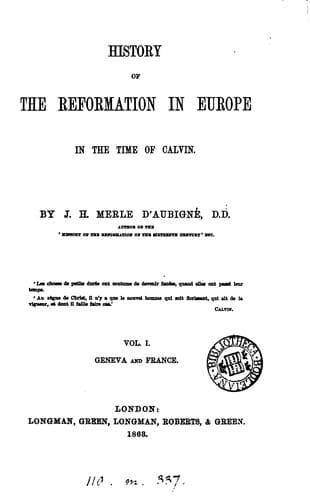
History of the Reformation in Europe in the Time of Calvin, Vol. 8 (of 8)Merle d'Aubigné, J. H. (Jean Henri)
History
History of the Reformation in Europe in the Time of Calvin, Vol. 8 (of 8)
Merle d'Aubigné, J. H. (Jean Henri)
Reformation
The Enzinas, having arrived in the Netherlands before 1540, applied
themselves zealously to their studies. They were all of them, and
especially Francis, desirous of discovering all that was true and
good, fully determined to communicate to others the truths which they
had acquired, filled with courage to defend them against all attacks
and with perseverance to continue in the face of danger faithful to
their convictions.[72] They had the Spanish temperament, depth and
fervor of soul, seriousness and reflectiveness of understanding; and
some faults of their nature were corrected by Christian faith. Their
language had not only stateliness but thought. The sense of honor did
not in them degenerate into pride, as is so often the case; and their
religious faith, by the influence of the Gospel, was preserved from
superstition. They have been known under different names in different
countries. Their family name, Enzinas, which in Spanish denotes a
species of oak, was as usual hellenized in Germany, where they bore the
name of Dryander, and was turned into French in France, where they were
sometimes called Duchesne.
These three young men had a taste for literature, and made rapid
progress in it. While the truly noble and liberal bent of their
intellect separated them from the theologians who were virtually
imprisoned within the walls of the Scholastic method and doctrine,
their naturally religious disposition, the common characteristic of
their countrymen, led them to seek out the pious men of their day. Two
of these were the means of bringing them over from Roman Catholicism to
evangelical Protestantism; both of them conciliatory men, who, though
they belonged especially to one of the two categories, maintained at
the same time some relations with the other. One of them stood on the
Catholic side, the other on the Protestant; but they had both been
desirous of bringing about a reconciliation between the Reformation
and Catholicism. One of these men was George Cassander, born in 1515,
probably in the island of Cassandria, at the mouth of the Scheldt.
He was a good scholar, and was a perfect master of languages and
literature, law and theology, and taught with great reputation in
various universities in the Netherlands. Sincerely pious, he made
it the purpose of his life to demonstrate the agreement of the two
parties in essential doctrines and to endeavor to unite them. With
this intent he published various works.[73] The emperor Ferdinand at a
later time requested him to work for this end. The Enzinas associated
themselves with him. An intimate friendship grew up between them; they
had frequent conversations and wrote to each other when separated.[74]
But while the Catholics thought that Cassander conceded too much to
the Protestants, the latter, and especially Calvin, complained that
he conceded too much to the Catholics. He did, in fact, remain always
united with the Roman church, declared that he submitted to its
Public-domain text, read in full here on John Shaqi.
Reviews
Reviews
No reviews yet
Be the first to share your thoughts on this work.
Join the Discussion
Join the discussion
Sign in to leave a comment or review.
Sign InorCreate an account