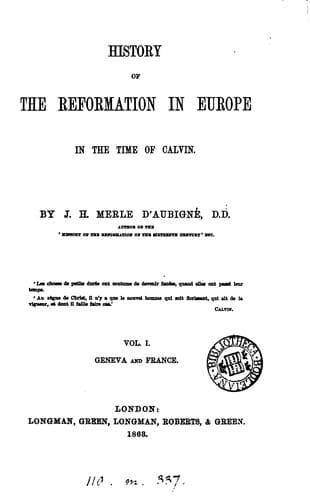
History of the Reformation in Europe in the Time of Calvin, Vol. 8 (of 8)Merle d'Aubigné, J. H. (Jean Henri)
History
History of the Reformation in Europe in the Time of Calvin, Vol. 8 (of 8)
Merle d'Aubigné, J. H. (Jean Henri)
Reformation
judgment, and openly condemned _schism_ and its authors.
The three brothers, endowed with an honest spirit, were resolved
to get to the bottom of things. The spirit of Cassander, timid, as
they thought, and the inadequacy of the reforms which he allowed
to be desirable, displeased them; and they gradually withdrew from
him. They looked for better guides, and studied the Holy Scriptures.
By public report they heard of Melanchthon, and they began to read
and to meditate on his writings. He was their second teacher, more
enlightened, more evangelical, and more illustrious than the first.
Melanchthon laid open to their understanding in a luminous manner the
sacred Epistles. He revealed to his reader the grace of Jesus Christ,
and this without the asperity and the violent language which are
sometimes to be met with in Luther. Melanchthon's moderation charmed
them. They had found their master.
[Sidenote: FRANCIS ENZINAS.]
About the close of 1537, Francis Enzinas, then from twenty to
twenty-five years of age, was recalled by his family to Burgos. His
relative, Peter de Lerma, had just been prosecuted by the Inquisition.
It was supposed that the views for which proceedings had been taken
against him were to be attributed to his sojourn at Paris. Those
inhabitants of Burgos who had sent their sons to foreign universities
were alarmed lest their children and themselves should be subjected to
the severities of the Inquisition. This was mainly the cause of the
return of Francis to Burgos. 'At that time,' says he, 'I was assailed
by earnest remonstrances on the part of my parents, and I began to be
looked on with suspicion by many great persons, because I would not
comply with their requirements and give up the studies, the savor of
which I had already tasted.'[75] His aged uncle, Peter de Lerma, was at
this time at Burgos. Francis went to see him, and found him unhappy and
dispirited, unable to reconcile himself to the thought of living in a
country where a man must either be in agreement with the Inquisition or
become its victim. 'Ah!' said he, 'I can no longer remain in Spain. It
is impossible for men of learning to dwell in safety in the midst of so
many persecutors.' What though he was now nearly eighty years old? What
though he must renounce, if he quitted Spain, all his goods and all his
honors? He determined to seek after another abode in which he might end
his days in peace. He would not hear of delay either on account of the
season of the year, when storms are most to be dreaded, or on account
of the war which was raging beyond the Pyrenees. He was resolved to
leave Spain immediately. Perhaps he was encouraged not to put off his
departure by the thought that the younger Enzinas might be of some
service to him in carrying out his project. The old man embarked on a
vessel which was sailing for Flanders. On his arrival there he betook
himself to Paris, where he had formerly resided. During his first
Public-domain text, read in full here on John Shaqi.
Reviews
Reviews
No reviews yet
Be the first to share your thoughts on this work.
Join the Discussion
Join the discussion
Sign in to leave a comment or review.
Sign InorCreate an account