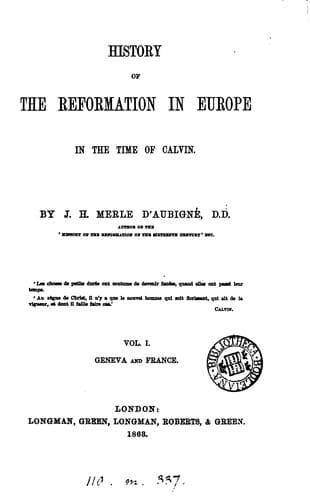
History of the Reformation in Europe in the Time of Calvin, Vol. 8 (of 8)Merle d'Aubigné, J. H. (Jean Henri)
History
History of the Reformation in Europe in the Time of Calvin, Vol. 8 (of 8)
Merle d'Aubigné, J. H. (Jean Henri)
Reformation
free,[103] nor from rising to the dwelling of the eternal Father to
contemplate heavenly things, nor from being there continually refreshed
by the sweet society of saints. Ah! would to God that the bonds of
this mortal body were already severed and that my soul could even now
take flight to my heavenly home! It is my firm assurance, that soon,
instead of these transient chains, everlasting joy in the glorious
presence of God will be given me by the just Judge.' Such was the faith
of the martyrs of the Reformation. There was something within them
that was free, _liberrimus animus_. There the emperor had nothing to
command, nothing to say. Thus it was that after the night and bondage
of the Middle Ages, our modern freedom took its rise. Holy and glorious
origin! San Romano's friend was so astonished and touched by these
words that he 'shed a torrent of tears.' His grief was so intense that
he could not speak, and answered only by tears and sighs. But soon the
guards, noticing perhaps this conversation, drove on at a great rate,
and the friends were separated.[104]
San Romano on his arrival in Spain was delivered over to the
Inquisition of Valladolid. The inquisitors threw him into a dark
prison, 'a most horrible subterranean hole,' says the French
translator. They subjected him to far more cruel treatment than he had
ever experienced from the soldiers; and he suffered more than in the
great dangers which he had incurred at sea, from the chains with which
he was loaded, and a thousand other torments. This took place in 1542,
and San Romano remained in prison about two years.[105]
CHAPTER IV.
THE NEW TESTAMENT IN SPANISH PRESENTED TO CHARLES THE FIFTH BY ENZINAS.
(1542-1545.)
While these events were passing, Francis Enzinas was working at
Wittenberg under the eye of Melanchthon at his translation of the New
Testament. The work was at last completed, and there remained only
to print it and send it to Spain. For this purpose Enzinas was to go
to Antwerp. He set off, therefore, from Wittenberg in the month of
January, 1543, just after his friend San Romano had been confined in
the dungeons of Valladolid. He first proceeded, by very bad roads, and
in the midst of winter, to Embden, where he wished to see John Alasco.
'We conferred on several matters, which he has no doubt communicated to
you,' wrote Francis to Melanchthon. Thence he went to the convent of
Adnard, in the neighborhood of Groningen, where Hardenberg then was.
This man's regard for the Gospel had abated, and he had determined to
pass the rest of his days in peace in his convent. Enzinas endeavored
to induce him openly to profess the doctrine of the Gospel. In this he
succeeded. Hardenberg left the convent and went to Cologne. Francis
went to Louvain, where he arrived in March, 1543.[106]
[Sidenote: ENZINAS AT LOUVAIN.]
Public-domain text, read in full here on John Shaqi.
Reviews
Reviews
No reviews yet
Be the first to share your thoughts on this work.
Join the Discussion
Join the discussion
Sign in to leave a comment or review.
Sign InorCreate an account