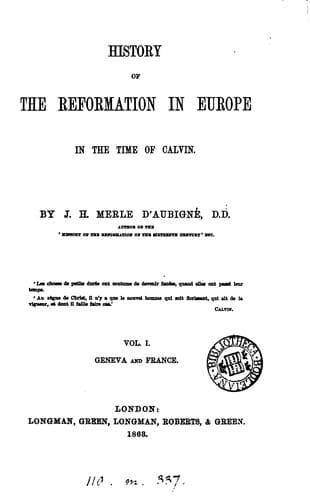
History of the Reformation in Europe in the Time of Calvin, Vol. 8 (of 8)Merle d'Aubigné, J. H. (Jean Henri)
History
History of the Reformation in Europe in the Time of Calvin, Vol. 8 (of 8)
Merle d'Aubigné, J. H. (Jean Henri)
Reformation
The moment was not favorable. The Inquisition and the secular power
itself were both preparing their terrors. There was an under-current
of agitation in the city; hatred or fear was everywhere rife.
Enzinas had many friends in the city; but knowing that he came from
Wittenberg, and pretending that he 'smelt of sulphur,' those with
whom he was most intimate, far from lavishing on him marks of tender
affection, as formerly, remained mute and trembled in his presence.
He well understood the reason. The very day after his arrival, the
Attorney-General, Peter du Fief, cast into prison, as we have seen
elsewhere,[107] all of the evangelical party who fell into his hands.
An uncle whom Enzinas had at Antwerp, Don Diego Ortega, invited him to
go and see him, and he was received in that town with open arms. At
this period he was alternately at Antwerp, Brussels, and Louvain.
The persecution which had befallen a great number of his friends now
absorbed all his thoughts; but when the storm had somewhat abated, his
project of publishing his Spanish translation of the New Testament
again engaged his attention. Being modest, as distinguished men
generally are, he felt some hesitation when he considered how great an
enterprise it was, especially for a young man like himself. 'I do not
wish,' he said, 'to accomplish this work in obedience to my own impulse
alone.' He therefore consulted several men belonging to different
nations and eminent for their learning and wisdom. All of them approved
his project, and begged him to hasten the printing. 'Since the birth of
Jesus Christ,' said some of the monks, even among the superstitious,
'so great a benefit has never been offered to the Spanish people.'
'I could wish,' said another, 'to see that book printed, were it
even with my own blood.'[108] Enzinas took another step even more
humble, and which might have compromised him. It was necessary that
theological books should receive the sanction of the faculty of
theology. 'Assuredly,' said Enzinas, 'this was never required, nor
ought to be required, for the Holy Scriptures. But no matter.' He sent
his translation to the dean of Louvain by a monk of his acquaintance.
The members of the faculty, after conferring together, replied, 'We
do not know Spanish; but we know that every heresy in the Netherlands
proceeded from reading the sacred books in the vulgar tongue. It
would, therefore, be advisable not to furnish the common people in
Spain with an opportunity of refuting the decrees of the Church by
the words of Jesus Christ, the prophets, and the apostles.[109] But
since the emperor has not forbidden it, we give neither permission nor
prohibition.' This reply was at least candid and ingenuous.
[Sidenote: THE SPANISH NEW TESTAMENT.]
Public-domain text, read in full here on John Shaqi.
Reviews
Reviews
No reviews yet
Be the first to share your thoughts on this work.
Join the Discussion
Join the discussion
Sign in to leave a comment or review.
Sign InorCreate an account