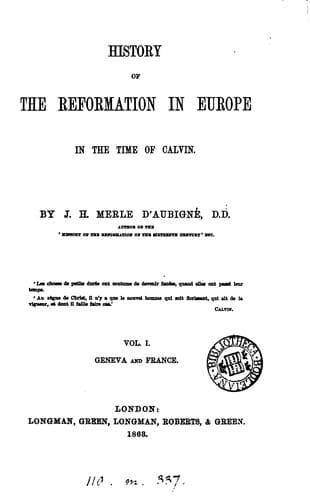
History of the Reformation in Europe in the Time of Calvin, Vol. 8 (of 8) — John Shaqi
History of the Reformation in Europe in the Time of Calvin, Vol. 8 (of 8)Merle d'Aubigné, J. H. (Jean Henri)
History
History of the Reformation in Europe in the Time of Calvin, Vol. 8 (of 8)
Merle d'Aubigné, J. H. (Jean Henri)
Reformation
Enzinas did not pay much regard to the advice of the theologians of
Louvain; but the work would have had a much larger circulation if it
had been sent out under their sanction. Now both prudence and zeal
incited him to do every thing to ensure the success of his enterprise.
Having met with this refusal, he contented himself with communicating
his manuscript to Spanish scholars, who declared that they had collated
the most important passages, and had found the translation very
faithful. They urged him, therefore, to hasten the publication of so
beneficial a work.[110] He now went once more to Antwerp, intending
to have his book printed there; but he was soon to discover that
his application to the theologians of the university of Louvain, by
spreading in a certain circle a report of his enterprise, sufficed to
throw great obstacles in his way.
There were, in fact, at this time in the Low Countries dignitaries of
the Spanish Church whose eyes were open and who would not fail to use
every effort to hinder the printing of the Holy Scriptures in Spanish.
Amongst others was the archbishop of Compostella, Don Gaspar d'Avalos,
a man whom Spanish devotees considered, on account of the perfection of
his ultramontane doctrine, as a divinity among mortals,[111] but whom
men of sound judgment regarded as a fanatic. Filled with abhorrence
for the holy doctrine of the Gospel, he took every opportunity of
contending against and uprooting it. He was the first to oppose the
translation of Enzinas. 'To publish the New Testament in Spanish,' said
he, 'is a crime worthy of death.' One day, when the archbishop and the
translator were both at Antwerp, the former preached. The Spaniards,
who were at this time numerous at Antwerp, were present, and many
others came out of mere curiosity. Enzinas slipped into the church,
and, wishing to hear well, succeeded in placing himself close to the
illustrious preacher. The latter, according to the taste of the Romish
priests, delivered a controversial sermon, and it must be confessed
that he had reasons for doing so. He thundered against the books which
set forth the doctrine of the Gospel. He did not preach, said Enzinas,
he vociferated, and strove by furious clamor to stir up his audience
and excite the people to sedition.[112] He went even further. Without
naming Enzinas, he hurled covert words at him, never suspecting that
the man whom he was attacking was sitting close by him.[113]
Francis, whether after or before this sermon we do not know, went to
Stephen Meerdmann the printer, and the following conversation took
place:--
_Enzinas_: 'Are you willing to print a Spanish translation of the New
Testament?'
_Meerdmann_: 'Quite willing; such a work is desired by many.'
_Enzinas_: 'Is there any need of a license?'
Public-domain text, read in full here on John Shaqi.
Reviews
Reviews
No reviews yet
Be the first to share your thoughts on this work.
Join the Discussion
Join the discussion
Sign in to leave a comment or review.
Sign InorCreate an account