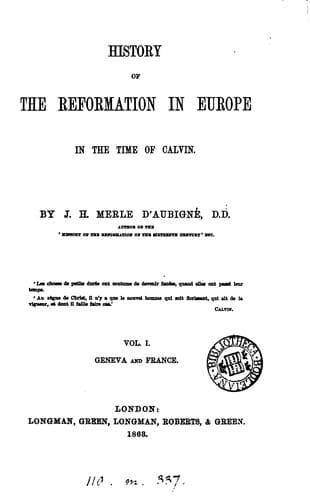
History of the Reformation in Europe in the Time of Calvin, Vol. 8 (of 8)Merle d'Aubigné, J. H. (Jean Henri)
History
History of the Reformation in Europe in the Time of Calvin, Vol. 8 (of 8)
Merle d'Aubigné, J. H. (Jean Henri)
Reformation
Having received this first printed sheet, Enzinas, through excess
of caution, communicated it to a Spaniard of his acquaintance, an
elderly, well-informed, and influential man. '_Only Saviour!_' cried
he, on seeing the title. 'If you will be advised by me, omit the word
_only_, which will give rise to grave suspicions.' Enzinas explained
his reasons. The Spaniard acknowledged the truth of the doctrine, but
denied the expediency of putting it so prominently forward. The word
was omitted, and the sheet had to be reprinted.[116] The whole edition
was some time after ready to appear.
[Sidenote: PEDRO DE SOTO.]
It was now the beginning of November, 1543. The emperor had just made
war against the Duke of Cleves, had conquered him, and had obtained
by the treaty of Venloo a portion of the states of that prince. The
duke's mother, the Princess Mary, a clever woman, had died of grief
and indignation;[117] but the emperor was proud of his achievements,
and thought only of following up his triumphs of every kind. It was
to his Spanish troops in particular that Charles owed this victory. A
great number of Spaniards of every rank accompanied him, and he had
just appointed as his confessor a Dominican from the Peninsula, Pedro
de Soto, who was afterwards the first theologian of Pius IV., in the
third convocation of the Council of Trent. At this time Soto ranked,
both in the Low Countries and in Germany, among the most zealous of
the Romish priests. He sought to gain over ignorant minds, and knew
how to insinuate himself into the good graces of the great. As he had
the emperor's conscience at his disposal he 'instilled into him his
venom,[118] thus perverting the sentiments of a prince who was full
of clemency,' says Enzinas. But this supposed benignity on Charles's
part was an illusion. Policy was his great guiding motive, and he was
merciful or harsh, according as the interests of his ambition required.
It is, however, true that Soto endeavored both by his sermons and
otherwise to inflame men's minds, and especially that of Charles,
against those whom he called heretics. Whenever the Dominican preached
before Charles the Fifth and his court, he was to be seen entering
the church in a lowly manner, his head sunk between his shoulders,
his cowl pulled over his forehead, his eyes fixed on the ground, and
his hands clasped.[119] One would have thought him a man dead to the
world, who contemplated only heavenly things, and who would not harm
a fly.[120] He mounted the pulpit, threw back his cowl and gravely
saluted the emperor, and the princes and lords who surrounded him. Then
he began his sermon, speaking with a low voice and slow enunciation,
but clearly and firmly, so that his words sank the more impressively
into men's hearts. He recalled with enthusiasm the religion of their
ancestors and extolled the piety and zeal of Charles. Then, affecting
to be more and more moved, he deplored with sighs and tears the ruin
Public-domain text, read in full here on John Shaqi.
Reviews
Reviews
No reviews yet
Be the first to share your thoughts on this work.
Join the Discussion
Join the discussion
Sign in to leave a comment or review.
Sign InorCreate an account