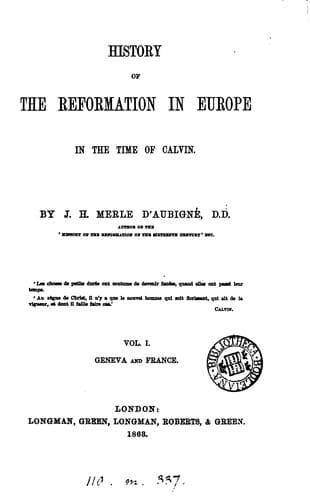
History of the Reformation in Europe in the Time of Calvin, Vol. 8 (of 8)Merle d'Aubigné, J. H. (Jean Henri)
History
History of the Reformation in Europe in the Time of Calvin, Vol. 8 (of 8)
Merle d'Aubigné, J. H. (Jean Henri)
Reformation
of religion and the attacks made upon the dignity of the priest, and
conjured the emperor to tread in the way marked out for him by his
predecessors. Having thus by feigned modesty insinuated himself into
the hearts of his audience, he raised his head boldly, gave vent
to the passion by which he was animated, and brought into play the
powerful artifices suggested to him by the Evil One.[121] He hurled
the thunders of his eloquence at his adversaries; he aimed a thousand
shafts at them, and subdued his audience. But if his violence took the
assembly by surprise, he shocked many, who thought with amazement: 'We
might fancy we were listening to a man who had descended from the abode
of the gods on Olympus to announce the secrets he had learned from
Jupiter,' 'He was seized,' said one of his hearers, 'with a diabolical
fury, and seemed like a priest of the mysteries, gesticulating and
leaping in a chorus of the Furies.'[122] He laid siege to the mind
of the emperor, and inflamed the princes with hatred of the divine
doctrine. This he distorted and defamed; and he strove by all means to
extinguish the salutary light of the Gospel which God had rekindled
in the midst of the darkness. Turning towards the emperor and the
princes, he proclaimed in a prophetic voice, that God would not be
favorable to them until they should have destroyed the apostates with
fire and sword. He did not conclude his discourse till he thought he
had constrained his hearers by his thundering eloquence to burn all the
Lutherans.
[Sidenote: HE INSTIGATES TO PERSECUTION.]
Nevertheless it was quite manifest that the emperor did not always use
such diligence as De Soto demanded of him in his seditious discourses.
Disquieted, therefore, and saddened because the monarch appeared
'backward to persecution,' he appealed to him in private, urging him to
make confession; and it was in the retired chamber in which he received
as a penitent the master of the world that he sought, by striking great
blows, to drive Charles on to persecution. 'Most sacred Majesty,' he
said, 'you are the monarch whom God has raised to the highest pitch
of honor, in order that you may defend the Church and take vengeance
on impiety, and I am the man whom God has appointed to govern your
conscience. Power has been given me, as your majesty is aware, to remit
and to retain sins. If your majesty does not purify the Church from
pollution, I can not absolve you, _ego non possum te absolvere_.' He
even menaced him with the anger of God and the pains of hell. Charles,
who was easily intimidated--even, as we know, by the approach of a
comet--'imagined himself already plunged into the abyss of hell.'[123]
The monk, perceiving this, pressed his point, and did not pronounce
absolution until he had extorted from the sovereign a promise to put
the heretics to death.
Public-domain text, read in full here on John Shaqi.
Reviews
Reviews
No reviews yet
Be the first to share your thoughts on this work.
Join the Discussion
Join the discussion
Sign in to leave a comment or review.
Sign InorCreate an account