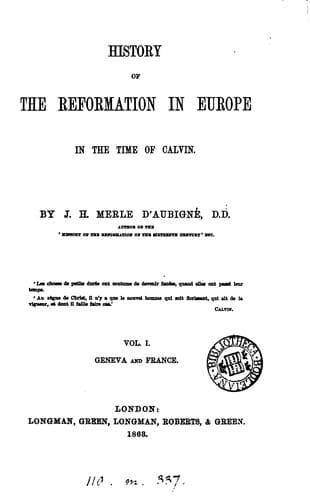
History of the Reformation in Europe in the Time of Calvin, Vol. 8 (of 8) — John Shaqi
History of the Reformation in Europe in the Time of Calvin, Vol. 8 (of 8)Merle d'Aubigné, J. H. (Jean Henri)
History
History of the Reformation in Europe in the Time of Calvin, Vol. 8 (of 8)
Merle d'Aubigné, J. H. (Jean Henri)
Reformation
This narrative by a contemporary appears to us perfectly authentic.
There is, however, one point on which we can not follow it. We do not
believe that De Soto was a hypocrite and employed fraud and treason,
as this author seems to think. Charles's confessor was, we believe,
a fanatic, but a sincere fanatic; he really believed himself to be
prosecuting error.
No sooner had De Soto obtained the promise of Charles than he hastened
to Granvella. It was said at court that these two personages had made
a compact, by virtue of which the first minister never thwarted the
confessor in matters of religion. It might be so; but we believe that
Charles did not lightly submit his designs to the fanaticism of the
priests, nor would he, we repeat, give them the rein unless it suited
his policy.
On November 24, 1543, Charles the Fifth, after having signed the treaty
of Venloo, entered Brussels, probably by the Louvain gate. Another
personage entered the city at the same time, but by the Antwerp gate.
This was Francis Enzinas. He had, as we have said, dedicated his
translation to the emperor. 'Most sacred majesty,' said he in this
dedication, 'owing to versions of the Holy Scriptures, all men can now
hear Jesus Christ and his apostles speak in their own languages of the
mysteries of our redemption, on which the salvation and the consolation
of our souls depend. New versions are now continually being published
in every kingdom of Christendom, in Italy, in Flanders, and in Germany,
which is flooded with them. Spain alone remains isolated in her corner
at the extremity of Europe. My desire is to be useful, according to my
abilities, to my country. I hope that your majesty will approve of my
work and protect it with your royal authority.' This dedication was
dated from Antwerp, October 1, 1543.
Enzinas did not wish his book to be offered for sale until he had
presented it to the emperor; and he had come to Brussels to confer with
his friends as to where he would have to go and how he should proceed.
As soon as he had arrived he directed his steps towards the palace,
where, no doubt, one of his acquaintances resided. On approaching he
saw to his great surprise the emperor himself; just arriving at court,
surrounded by a numerous suite.[124] At this sight Francis greatly
rejoiced. 'What a happy augury!' thought he; 'this opportune meeting
should certainly give me hope that my business will succeed.'
Public-domain text, read in full here on John Shaqi.
Reviews
Reviews
No reviews yet
Be the first to share your thoughts on this work.
Join the Discussion
Join the discussion
Sign in to leave a comment or review.
Sign InorCreate an account