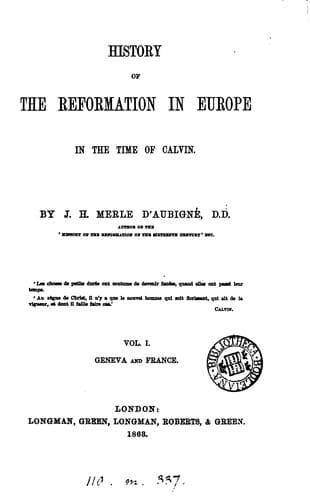
History of the Reformation in Europe in the Time of Calvin, Vol. 8 (of 8)Merle d'Aubigné, J. H. (Jean Henri)
History
History of the Reformation in Europe in the Time of Calvin, Vol. 8 (of 8)
Merle d'Aubigné, J. H. (Jean Henri)
Reformation
Nevertheless he took courage and, bearing witness to the Gospel,
extolled the unspeakable value of Holy Scripture, and set forth the
reasons which he felt to be conclusive for reading it. 'The Old and
New Testaments,' he said, 'were given to us from heaven, and there
is nothing more salutary or more essential to mankind. Apart from
this book we should know nothing of the only-begotten Son of God, our
Saviour, who, after having redeemed us by the sacrifice of himself,
raises us to heaven to live there with him forever. This is a doctrine
which was never taught by any philosopher, and is only to be drawn
from these sources. Without it, all human thought is blind and barren,
and no creature can obtain salvation.'[138] He said that if it were a
crime to go to Germany and to confer with the scholars of that country,
it was a crime which had been committed by the emperor, and by many
princes and excellent men who had conversed with Melanchthon, Luther,
and other doctors. He was still speaking when an unpleasant apparition
silenced him. The door had opened, and a monk of hideous aspect entered
the cell. His eyes were fierce, his mouth awry, his aspect threatening.
Every thing about him betokened a bad man, and one who was meditating
some cruel purpose. It was the prior of the Dominicans. He turned
towards Enzinas, and suppressing his malice, meekly withdrew his head
from his cowl, saluted him, and stated that his valet was below and
was come to call him to supper. This was the message agreed on between
the two monks as the signal that all was ready. 'I know the way,'
said Enzinas, who was bent on prolonging the interview; 'I shall find
my lodging without the aid of a servant; please tell him that he may
return to the house.' The prior went out. Enzinas then requested the
confessor to tell him his opinion of the translation, as the emperor
had asked for this, and it was indeed the object of their conference.
But the signal appointed had been given, and the confessor put an end
to the interview. 'It is too late now,' said he, 'come again to-morrow
if it suits you.' Enzinas, therefore, fearing to be importunate, took
leave of the monk, and De Soto's servant conducted him as far as the
court-yard. But gloomy thoughts were crowding into his mind. As he
passed through the convent he had seen a number of monks, in a state of
eagerness and excitement, some going up, others going down. In their
looks he saw strange agitation and fierceness. They cast upon him
sidelong glances expressive of terror; they spoke low to one another,
and uttered words which Enzinas could not understand.[139] It was
evident that this immoderate agitation in the monastery and among the
inmates was occasioned by some unusual occurrence. Francis conjectured
what it might be; it began to arouse anxiety in his breast; and he
wondered whether some great blow was about to fall on him.
Public-domain text, read in full here on John Shaqi.
Reviews
Reviews
No reviews yet
Be the first to share your thoughts on this work.
Join the Discussion
Join the discussion
Sign in to leave a comment or review.
Sign InorCreate an account