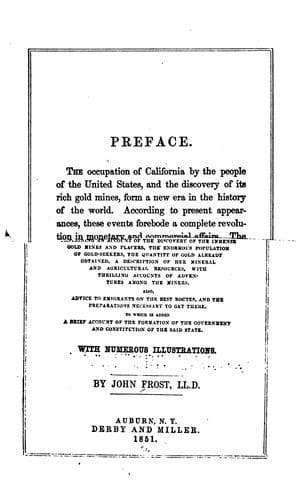
History of the State of California: From the Period of the Conquest by Spain to Her Occupation by the United States of AmericaFrost, John
History
History of the State of California: From the Period of the Conquest by Spain to Her Occupation by the United States of America
Frost, John
California -- Gold discoveries; California -- History
miles through a barren country, the trail is followed to "Fort
Bernard," a small building, rudely constructed of logs, used as a
trading-post. Eight miles farther on, is Fort Laramie, or Fort John,
as it is sometimes called. This fort has been the principal
trading-post of the American Fur Company. It is situated in the
Laramie River, near its junction with the Platte, and is six hundred
and seventy-two miles from Independence. The building is
quadrangular, and is constructed of _adobé_, or sun-dried bricks. Its
walls are surmounted by watch-towers and its gate is defended by two
brass swivels.
From Fort Laramie, the trail continues on through a broken country, to
the Platte River, a distance of twenty miles. Crossing a small creek
which empties into the Platte, it proceeds through the dry bed of one
of its branches, over a deep sand for six or eight miles, and reaches
the summit of a high ridge. From thence it descends into a narrow
valley, through which flows a small stream of pure water. Another
ridge of hills is then ascended, and a wild, desolate, but picturesque
scene is presented to the view. Numerous lofty mountain peaks, barren
rocks, and a vast prospect of low conical hills are the principal
features. Through a country, the principal features of which are of
this description, the trail is followed, and the monotony of the
journey is only relieved by an occasional stoppage at a refreshing
spring of water. The trail gradually ascends towards the summit of the
Rocky Mountains, and the country becomes more broken and sterile, till
it reaches Beaver Creek, a tributary of the Platte. There the grass
and water are good, and the wood is abundant. The country exhibits
every indication of fertility upon the trail leading from Beaver
Creek, and pure and limpid streams are frequent, until the Platte
River is again struck and followed upon its southern bank, for the
distance of about eighteen miles. The river is then forded, and the
trail ascends the high bluffs overlooking the valley, and proceeds
over several miles of table-land till the valley of the Platte is
again reached. At this point, the trail finally leaves the Platte,
and, ascending the bluffs on the right, passes over an arid plain
diversified with immense piles of rocks, deep ravines and chasms, and
presenting a wide-spread sterility and desolation, for the distance of
forty miles. Water is to be obtained in very small quantities and at
few places on this part of the trail, and, therefore a scarcity should
be provided for before leaving the Platte. At the end of that
distance, the trail descends into a small valley, where spring water
can be obtained and some refreshing shade. Ascending from this valley,
the trail gradually ascends to the summit of a dividing ridge, from
which a view of the Sweetwater River Mountains can be obtained.
Descending from the ridge, a small stream, the grassy banks of which
serve for an encampment, is soon reached. Farther on is a well-known
Public-domain text, read in full here on John Shaqi.
Reviews
Reviews
No reviews yet
Be the first to share your thoughts on this work.
Elsewhere in the archive
Join the Discussion
Join the discussion
Sign in to leave a comment or review.
Sign InorCreate an account