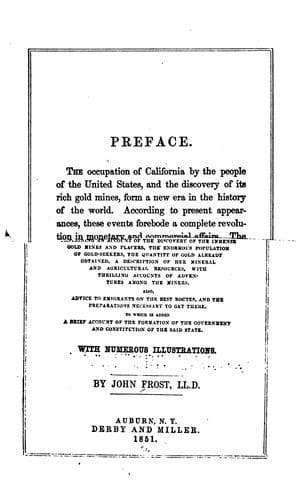
History of the State of California: From the Period of the Conquest by Spain to Her Occupation by the United States of AmericaFrost, John
History
History of the State of California: From the Period of the Conquest by Spain to Her Occupation by the United States of America
Frost, John
California -- Gold discoveries; California -- History
Early in September, Commodore Stockton withdrew his forces from Los
Angeles, and proceeded with his squadron to San Francisco. Scarcely
had he arrived when he received intelligence that all the country
below Monterey was in arms and the Mexican flag again hoisted. The
Californians invested the "City of the Angels," on the 23d of
September. That place was guarded by thirty riflemen under Captain
Gillespie, and the Californians investing it numbered 300. Finding
himself overpowered, Captain Gillespie capitulated on the 30th, and
thence retired with all the foreigners aboard of a sloop-of-war, and
sailed for Monterey. Lieutenant Talbot, who commanded only nine men at
Santa Barbara, refused to surrender, and marched out with his men,
arms in hand. The frigate Savannah was sent to relieve Los Angeles,
but she did not arrive till after the above events had occurred. Her
crew, numbering 320 men, landed at San Pedro and marched to meet the
Californians. About half way between San Pedro and Los Angeles, about
fifteen miles from their ship, the sailors found the enemy drawn up on
a plain. The Californians were mounted on fine horses, and with
artillery, had every advantage. The sailors were forced to retreat
with a loss of five killed and six wounded.
Commodore Stockton came down in the Congress to San Pedro, and then
marched for the "City of the Angels," the men dragging six of the
ship's guns. At the Rancho Sepulvida, a large force of the
Californians was posted. Commodore Stockton sent one hundred men
forward to receive the fire of the enemy and then fall back upon the
main body without returning it. The main body was formed in a
triangle, with the guns hid by the men. By the retreat of the advance
party, the enemy were decoyed close to the main force, when the wings
were extended and a deadly fire opened upon the astonished
Californians. More than a hundred were killed, the same number
wounded, and their whole force routed. About a hundred prisoners were
taken, many of whom were at the time on parole and had signed an
obligation not to take up arms during the war.
Public-domain text, read in full here on John Shaqi.
Reviews
Reviews
No reviews yet
Be the first to share your thoughts on this work.
Join the Discussion
Join the discussion
Sign in to leave a comment or review.
Sign InorCreate an account