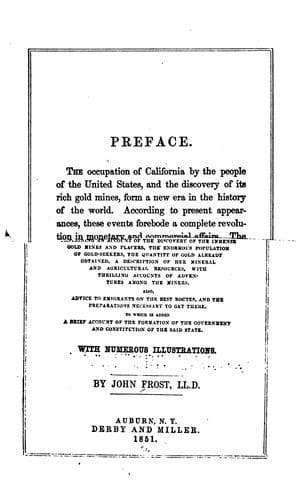
History of the State of California: From the Period of the Conquest by Spain to Her Occupation by the United States of AmericaFrost, John
History
History of the State of California: From the Period of the Conquest by Spain to Her Occupation by the United States of America
Frost, John
California -- Gold discoveries; California -- History
Commodore Stockton soon mounted his men and prepared for operations on
shore. Skirmishes followed, and were continually occurring until
January, 1847, when a decisive action occurred. General Kearny had
arrived in California, after a long and painful march overland, and
his co-operation was of great service to Stockton. The Americans left
San Diego on the 29th of December, to march to Los Angeles. The
Californians determined to meet them on their route, and decide the
fate of the country in a general battle. The American force amounted
to six hundred men, and was composed of detachments from the ships
Congress, Savannah, Portsmouth and Cyane, aided by General Kearny,
with sixty men on foot, from the first regiment of United States
dragoons, and Captain Gillespie with sixty mounted riflemen. The
troops marched one hundred and ten miles in ten days, and, on the 8th
of January, they found the Californians in a strong position on the
high bank of the San Gabriel river, with six hundred mounted men and
four pieces of artillery, prepared to dispute the passage of the
river. The Americans waded through the water, dragging their guns with
them, exposed to a galling fire from the enemy, without returning a
shot. When they reached the opposite shore, the Californians charged
upon them, but were driven back. They then charged up the bank and
succeeded in driving the Californians from their post. Stockton, with
his force, continued his march, and the next day, in crossing the
plains of Mesa, the enemy made another attempt to save their capital.
They were concealed with their artillery in a ravine, until the
Americans came within gun-shot, when they opened a brisk fire upon
their right flank, and at the same time charged both their front and
rear. But the guns of the Californians were soon silenced, and the
charge repelled. The Californians then fled, and the next morning the
Americans entered Los Angeles without opposition. The loss of the
Americans in killed and wounded did not exceed twenty, while that of
their opponents reached between seventy and eighty.
These two battles decided the contest in California. General Flores,
governor and commandant-general of the Californians, as he styled
himself, immediately after the Americans entered Los Angeles, made his
escape and his troops dispersed. The territory became again tranquil,
and the civil government was soon in operation again in the places
where it had been interrupted by the revolt. Commodore Stockton and
General Kearny having a misunderstanding about their respective
powers, Colonel Fremont exercised the duties of governor and
commander-in-chief of California, declining to obey the orders of
General Kearny.
Public-domain text, read in full here on John Shaqi.
Reviews
Reviews
No reviews yet
Be the first to share your thoughts on this work.
Join the Discussion
Join the discussion
Sign in to leave a comment or review.
Sign InorCreate an account