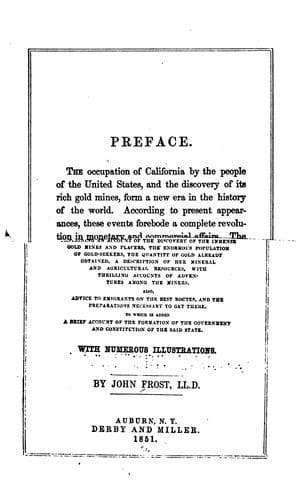
History of the State of California: From the Period of the Conquest by Spain to Her Occupation by the United States of AmericaFrost, John
History
History of the State of California: From the Period of the Conquest by Spain to Her Occupation by the United States of America
Frost, John
California -- Gold discoveries; California -- History
Interesting proceedings have taken place in the United States Senate,
in regard to the Tehuantepec route to California. The Mexican
government has shown a disposition to prevent the construction of a
road across Tehuantepec, which some senators think should be promptly
rebuked. In a recent speech upon the subject, Mr. Mason, of Virginia,
said that the acquisition of California and the intervening territory,
placed this Government in the position of having some of its
dependencies almost inaccessible. The discovery of the gold in
California, made the subject of a communication with that region, of
the deepest importance, and has naturally drawn the eyes of the world
to the necessity of securing some safe, reliable, and speedy right of
way to the Pacific Ocean. Panama has been sought, and it has been used
as a place of transit, without any serious objection on the part of
any government there. Mexico alone has interposed an obstacle to this
desired communication with the Pacific. Mexico, from whom our
territory was derived, and who is our neighbor and sister Republic,
has alone refused the right of way to the world, and has not only
refused the right of transit to other nations, but has also set aside
an existing grant of that right. For years, enterprises have been
projected to connect the two Oceans at Tehuantepec. In view of the
vast importance of this connection, the minds of the people of the
United States have been concentrated upon the discovery of that plan
which shall be the least expensive, and at the same time the most
certain and efficient, to unite the two Oceans by means of travel or
transportation. Mr. Mason read a table showing the distance between
New York and San Francisco by the Chagres route, to be 6650 miles;
between New Orleans and San Francisco, by way of Chagres, 5675 miles;
between New York and San Francisco, by the Tehuantepec route, 4970;
between New Orleans and San Francisco, by the Tehuantepec, 3740 miles.
The average time from New York to San Francisco, by the Chagres route,
was 28 days, and the shortest 24 days. The average time by the
Tehuantepec route was 19 days, and the shortest 15. From New Orleans,
by way of Tehuantepec, the average time would be 14 days and
the shortest 12 days.
It is believed that spirited action on the part of our government will
secure from Mexico the recognition of a right of way across
Tehuantepec, which, according to Senator Mason's able representation,
is but a matter of justice. Mexico is at present almost ready to fall
to pieces, most of its states, or provinces, being in successful
rebellion. She is not, therefore, in a condition to resist a
formidable foreign power. It is lamentable when a government is weak,
and yet dares to be unjust. The people of California have a
considerable stake in the decision of the Tehuantepec question.
Public-domain text, read in full here on John Shaqi.
Reviews
Reviews
No reviews yet
Be the first to share your thoughts on this work.
Elsewhere in the archive
Join the Discussion
Join the discussion
Sign in to leave a comment or review.
Sign InorCreate an account