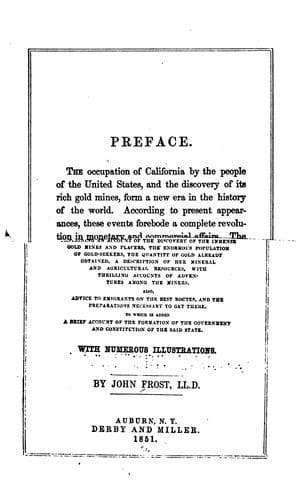
History of the State of California: From the Period of the Conquest by Spain to Her Occupation by the United States of AmericaFrost, John
History
History of the State of California: From the Period of the Conquest by Spain to Her Occupation by the United States of America
Frost, John
California -- Gold discoveries; California -- History
On the 7th the march was resumed, and, near San Bernardo, Kearny's
advance encountered and defeated a small party of the Californians who
had taken post on a hill. At San Bernardo, the troops remained till
the morning of the 11th, when they were joined by a party of sailors
and marines, under Lieutenant Gray. They then proceeded upon their
march, and on the 12th, arrived at San Diego; having thus completed a
march of eleven hundred miles through an enemy's country, with but one
hundred men. The force of General Kearny having joined that of
Commodore Stockton, the expedition against Los Angeles, of which we
have given an account in this chapter, was successfully consummated,
and tranquillity restored in California. General Kearny and Commodore
Stockton returned to the United States in January, 1847, leaving
Colonel Fremont to exercise the office of governor and military
commandant of California. No further events of an importance worth
recording occurred till the treaty of peace between the United States
and Mexico.
CHAPTER VI.
DISCOVERY OF THE GOLD PLACERS.
By the treaty concluded between the United States and Mexico, in 1847,
the territory of Upper California became the property of the United
States. Little thought the Mexican government of the value of the land
they were ceding, further than its commercial importance; and,
doubtless, little thought the buyers of the territory, that its soil
was pregnant with a wealth untold, and that its rivers flowed over
golden beds.
This territory, now belonging to the American Union, embraces an area
of 448,961 square miles. It extends along the Pacific coast, from
about the thirty-second parallel of north latitude, a distance of near
seven hundred miles, to the forty-second parallel, the southern
boundary of Oregon. On the east, it is bounded by New Mexico. During
the long period which transpired between its discovery and its cession
to the United States, this vast tract of country was frequently
visited by men of science, from all parts of the world. Repeated
examinations were made by learned and enterprising officers and
civilians; but none of them discovered the important fact, that the
mountain torrents of the Sierra Nevada were constantly pouring down
their golden sands into the valleys of the Sacramento and San Joaquin.
The glittering particles twinkled beneath their feet, in the ravines
which they explored, or glistened in the watercourses which they
forded, yet they passed them by unheeded. Not a legend or tradition
was heard among the white settlers, or the aborigines, that attracted
their curiosity. A nation's ransom lay within their grasp, but,
strange to say, it escaped their notice--it flashed and sparkled all
in vain.[1]
Public-domain text, read in full here on John Shaqi.
Reviews
Reviews
No reviews yet
Be the first to share your thoughts on this work.
Join the Discussion
Join the discussion
Sign in to leave a comment or review.
Sign InorCreate an account