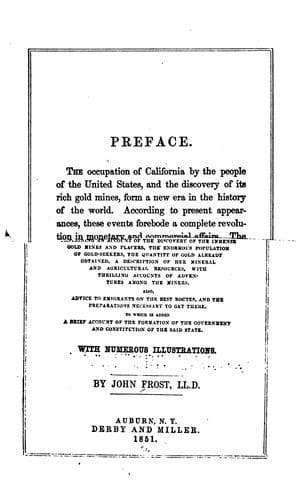
History of the State of California: From the Period of the Conquest by Spain to Her Occupation by the United States of AmericaFrost, John
History
History of the State of California: From the Period of the Conquest by Spain to Her Occupation by the United States of America
Frost, John
California -- Gold discoveries; California -- History
The Russian American Company had a large establishment at Ross and
Bodega, ninety miles north of San Francisco, founded in the year 1812;
and factories were also established in the territory by the Hudson Bay
Company. Their agents and _employes_ ransacked the whole country west
of the Sierra Nevada, or Snowy Mountain, in search of game. In 1838,
Captain Sutter, formerly an officer in the Swiss Guards of Charles
X., King of France, emigrated from the state of Missouri to Upper
California, and obtained from the Mexican government a conditional
grant of thirty leagues square of land, bounded on the west by the
Sacramento river. Having purchased the stock, arms, and ammunition of
the Russian establishment, he erected a dwelling and fortification on
the left bank of the Sacramento, about fifty miles from its mouth, and
near what was termed, in allusion to the new settlers, the American
Fork. This formed the nucleus of a thriving settlement, to which
Captain Sutter gave the name of New Helvetia. It is situated at the
head of navigation for vessels on the Sacramento, in latitude 38° 33'
45" north, and longitude 121° 20' 05" west. During a residence of ten
years in the immediate vicinity of the recently discovered _placéras_,
or gold regions, Captain Sutter was neither the wiser nor the richer
for the brilliant treasures that lay scattered around him.[2]
In the year 1841, careful examinations of the Bay of San Francisco,
and of the Sacramento River and its tributaries, were made by
Lieutenant Wilkes, the commander of the Exploring Expedition; and a
party under Lieutenant Emmons, of the navy, proceeded up the valley of
the Willamette, crossed the intervening highlands, and descended the
Sacramento. In 1843-4, similar examinations were made by Captain,
afterwards Lieutenant-Colonel Fremont, of the Topographical Engineers,
and in 1846, by Major Emory, of the same corps. None of these officers
made any discoveries of minerals, although they were led to
conjecture, as private individuals who had visited the country had
done, from its volcanic formation and peculiar geological features,
that they might be found to exist in considerable quantities.[3]
Public-domain text, read in full here on John Shaqi.
Reviews
Reviews
No reviews yet
Be the first to share your thoughts on this work.
Join the Discussion
Join the discussion
Sign in to leave a comment or review.
Sign InorCreate an account