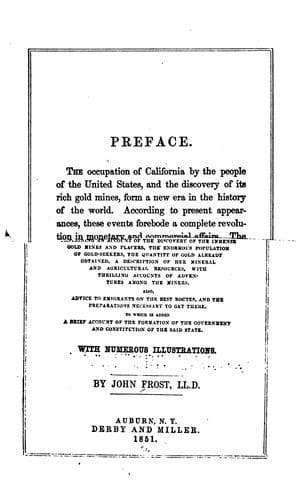
History of the State of California: From the Period of the Conquest by Spain to Her Occupation by the United States of AmericaFrost, John
History
History of the State of California: From the Period of the Conquest by Spain to Her Occupation by the United States of America
Frost, John
California -- Gold discoveries; California -- History
As is often the case, chance at length accomplished what science had
failed to do. In the winter of 1847-8, a Mr. Marshall commenced the
construction of a saw-mill for Captain Sutter, on the north branch of
the American Fork, and about fifty miles above New Helvetia, in a
region abounding with pine timber. The dam and race were completed,
but on attempting to put the mill in motion, it was ascertained that
the tail-race was too narrow to permit the water to escape with
perfect freedom. A strong current was then passed in, to wash it wider
and deeper, by which a large bed of mud and gravel was thrown up at
the foot of the race. Some days after this occurrence, Mr. Marshall
observed a number of brilliant particles on this deposit of mud, which
attracted his attention. On examining them, he became satisfied that
they were gold, and communicated the fact to Captain Sutter. It was
agreed between them, that the circumstance should not be made public
for the present; but, like the secret of Midas, it could not be
concealed. The Mormon emigrants, of whom Mr. Marshall was one, were
soon made acquainted with the discovery, and in a few weeks all
California was agitated with the startling information.
Business of every kind was neglected, and the ripened grain was left
in the fields unharvested. Nearly the whole population of Upper
California became infected with the mania, and flocked to the mines.
Whalers and merchant vessels entering the ports were abandoned by
their crews, and the American soldiers and sailors deserted in scores.
Upon the disbandment of Colonel Stevenson's regiment, most of the men
made their way to the mineral regions. Within three months after the
discovery, it was computed that there were near four thousand persons,
including Indians, who were mostly employed by the whites, engaged in
washing for gold. Various modes were adopted to separate the metal
from the sand and gravel--some making use of tin pans, others of
close-woven Indian baskets, and others still, of a rude machine called
the cradle, six or eight feet long, and mounted on rockers, with a
coarse grate, or sieve, at one end, but open at the other. The
washings were mainly confined to the low wet grounds, and the margins
of the streams--the earth being rarely disturbed more than eighteen
inches below the surface. The value of the gold dust obtained by each
man, per day, is said to have ranged from ten to fifty dollars, and
sometimes even to have far exceeded that. The natural consequence of
this state of things was, that the price of labor, and, indeed, of
every thing, rose immediately from ten to twenty fold.[4]
Public-domain text, read in full here on John Shaqi.
Reviews
Reviews
No reviews yet
Be the first to share your thoughts on this work.
Join the Discussion
Join the discussion
Sign in to leave a comment or review.
Sign InorCreate an account