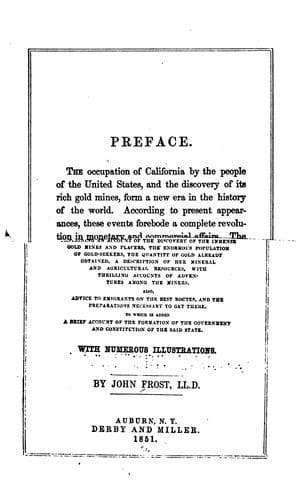
History of the State of California: From the Period of the Conquest by Spain to Her Occupation by the United States of AmericaFrost, John
History
History of the State of California: From the Period of the Conquest by Spain to Her Occupation by the United States of America
Frost, John
California -- Gold discoveries; California -- History
The country claimed by Cortes for Spain, was the south-east portion of
the peninsula, which was afterwards called California. The bay, called
by Cortes, Santa Cruz, was, perhaps, the same now known as Port La
Paz, about a hundred miles from the Pacific, near the 24th parallel of
latitude. Cortes landed on the shore of this bay, rocky and forbidding
as it appeared, with a hundred and thirty men, and forty horses. He
then sent back two of his ships to Chiametla, to bring over the rest
of his troops. The vessels soon returned with a portion of the troops,
and being again despatched to the Mexican coast, only one of them
returned. The other was wrecked on her way. Cortes then took seventy
men and embarked for Xalisco, from which he returned just in time to
save his troops from death by famine. A year was spent in these
operations, and the troops began to grow discontented. A few pearls
had been found on the coast, but the country was found to be barren,
and without attractions for Spaniards.
In the mean time, the wife of Cortes hearing reports of his ill
success, sent a vessel to Santa Cruz, and entreated him to return. He
then learned that he had been superseded in the government of New
Spain by Don Antonio de Mendoza, who had already entered the capital
as viceroy. Cortes returned to Mexico, and soon after, recalled the
vessels and troops from Santa Cruz.
The viceroy, Mendoza, had received some information concerning the
country north-west of Mexico, from de Cabeza-Vaca and two other
Spaniards, who had wandered nine years, through forests and deserts,
from Tampa Bay, Florida, until they reached Culiacan. They had
received from the natives, accounts of rich and populous countries
situated to the north-west. Mendoza, wishing to ascertain the truth of
the reports, sent two friars, according to the advice of Las Casas, to
make an exploration. They were accompanied by a Moor who had crossed
the continent with Cabeza-Vaca and his friends, and they set out from
Culiacan on the 7th of March, 1539.
Public-domain text, read in full here on John Shaqi.
Reviews
Reviews
No reviews yet
Be the first to share your thoughts on this work.
Join the Discussion
Join the discussion
Sign in to leave a comment or review.
Sign InorCreate an account