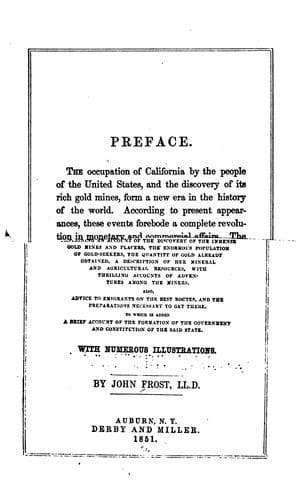
History of the State of California: From the Period of the Conquest by Spain to Her Occupation by the United States of AmericaFrost, John
History
History of the State of California: From the Period of the Conquest by Spain to Her Occupation by the United States of America
Frost, John
California -- Gold discoveries; California -- History
Soon after the departure of the friars, Cortes sent out his last
expedition. It was commanded by Francisco de Ulloa, and consisted of
three vessels, well equipped. Sailing from Acapulco, on the 8th of
July 1539, Ulloa reached the Bay of Santa Cruz, after losing one of
his vessels in a storm. From Santa Cruz he started to survey the coast
towards the north-west. He completely examined both shores of the Gulf
of California, and discovered the fact of the connection of the
peninsula with the main land, near the 32° of latitude. This gulf
Ulloa named the Sea of Cortes. On the 18th of October, he returned to
Santa Cruz, and on the 29th again sailed with the object of exploring
the coasts farther west. He rounded the point now called Cape San
Lucas, the southern extremity of California, and sailed along the
coast towards the north. The Spaniards proceeded slowly, as they were
opposed by north-western storms, and often landed and fought with the
natives. In January, 1540, Ulloa reached the island under the 28th
parallel of latitude, near the coast, which they named the Isle of
Cedars. There he remained till April, when one of the ships, bearing
the sick and accounts of the discoveries, was sent back to Mexico. The
returning vessel was seized at Santiago by the officers of the
viceroy. The fate of the remaining vessel is uncertain. Some of the
writers of that day asserting that he continued his voyage as far
north as the 30° of latitude, and returned safely to Mexico; while one
asserts that nothing more was heard of him after the return of the
vessel he sent back.
In the mean time, the two friars and the Moor penetrated a
considerable distance into the interior of the continent, and sent
home glowing accounts of rich and delightful countries which they said
they had discovered. The inhabitants had, at first, been hostile, and
had killed the Moor; but in the end submitted to the authority of the
King of Spain. Mendoza, believing the accounts of the friars to be
strictly true, prepared an expedition for the conquest of the
countries they described. Disputes with the different Spanish
chieftains occupied some months, at the end of which Cortes returned
to Spain, in disgust. Mendoza despatched two bodies of troops, one by
land, the other by sea, to reconnoitre the newly discovered land, and
clear the way for conquest. The marine expedition was undertaken by
two ships, under the command of Fernando de Alarcon, who sailed from
Santiago on the 9th of May, 1540, and proceeding north-west along the
coast, he reached the head of the California Gulf, in August of the
same year. There he discovered the river now called the Colorado. The
stream was ascended to the distance of eighty leagues, by Alarcon and
some of his men, in boats; but all their inquiries were
unsatisfactorily answered, and it was determined to return to Mexico.
The vessels returned safely before the end of the year.
Public-domain text, read in full here on John Shaqi.
Reviews
Reviews
No reviews yet
Be the first to share your thoughts on this work.
Join the Discussion
Join the discussion
Sign in to leave a comment or review.
Sign InorCreate an account