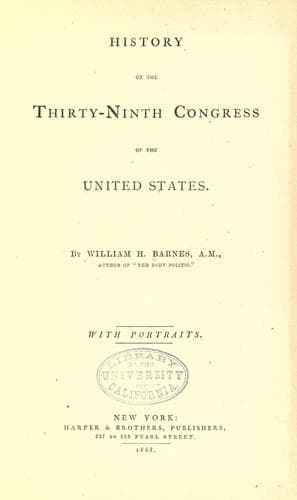
History of the Thirty-Ninth Congress of the United StatesBarnes, William Horatio
History
History of the Thirty-Ninth Congress of the United States
Barnes, William Horatio
United States -- Politics and government -- 1865-1869; United States. Congress (39th : 1865-1867)
"Let us see," said Mr. Clark, "how that may be. Take the gentleman's
own ground that government is a partnership, and those who did not
enter into it and take an active part in it can not be citizens. Is a
woman a citizen under our Constitution?"
"Not to vote," said Mr. Davis.
"I did not ask about voting," said Mr. Clark. "The gentleman said
awhile ago that voting did not constitute citizenship. I want to know
if she is a citizen. Can she not sue and be sued, contract, and
exercise the rights of a citizen?"
"So can a free negro," said Mr. Davis.
"Then, if a free negro can do all that," said Mr. Clark; "why is he
not a citizen?"
"Because he is no part of the governing power; that is the reason,"
Mr. Davis replied.
"I deny that," said Mr. Clark, "because in some of the States he is a
part of the governing power. The Senator only begs the question; it
only comes back to this, that a nigger is a nigger." [Laughter.]
"That is the whole of it," said Mr. Davis.
[Illustration: Hon. Reverdy Johnson.]
"That is the whole of the gentleman's logic," said Mr. Clark.
In answer to the statement insisted on by Mr. Davis, "You can not make
a citizen of any body that is not a foreigner," Mr. Johnson said:
"That would be an extraordinary condition for the country to be in.
Here are four million negroes. They are not foreigners, because they
were born in the United States. They have no foreign allegiance to
renounce, because they owed no foreign allegiance. Their allegiance,
whatever it was, was an allegiance to the Government of the United
States alone. They can not come, therefore, under the naturalizing
clause; they can not come, of course, under the statutes passed in
pursuance of the power conferred upon Congress by that clause; but
does it follow from that that you can not make them citizens; that the
Congress of the United States, vested with the whole legislative power
belonging to the Government, having within the limits of the United
States four million people anxious to become citizens, and when you
are anxious to make them citizens, have no power to make them
citizens? It seems to me that to state the question is to answer it.
Public-domain text, read in full here on John Shaqi.
Reviews
Reviews
No reviews yet
Be the first to share your thoughts on this work.
Elsewhere in the archive
Join the Discussion
Join the discussion
Sign in to leave a comment or review.
Sign InorCreate an account