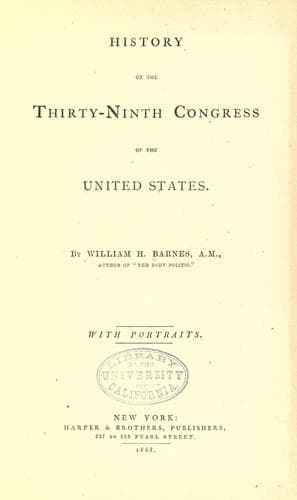
History of the Thirty-Ninth Congress of the United StatesBarnes, William Horatio
History
History of the Thirty-Ninth Congress of the United States
Barnes, William Horatio
United States -- Politics and government -- 1865-1869; United States. Congress (39th : 1865-1867)
The debate was closed by Mr. Wilson, Chairman of the Judiciary
Committee. He said: "This bill, sir, has met with opposition in both
houses on the same ground that, in times gone by, before this land was
drenched in blood by the slaveholders' rebellion, was urged by those
who controlled the destinies of the southern portion of the country,
and those who adhered to their fortunes in the North, for the purpose
of riveting the chains of slavery and converting this republic into a
great slave nation. The arguments which have been urged against this
bill in both houses are but counterparts of the arguments used in
opposition to the authority the Government sought to exercise in
controlling and preventing the spread of slavery.
"Citizens of the United States, as such, are entitled to certain
rights, and, being entitled to those rights, it is the duty of the
Government to protect citizens in the perfect enjoyment of them. The
citizen is entitled to life, liberty, and the right to property. The
gentleman from Ohio tells us, in the protection of these rights, the
citizen must depend upon the 'honest purpose of the several States,'
and that the General Government can not interpose its strong right arm
to defend the citizen in the enjoyment of life, liberty, and in
possession of property. In other words, if the States of this Union,
in their 'honest purpose,' like the honesty of purpose manifested by
the Southern States in times past, should deprive the citizen, without
due process of law, of life, liberty, and property, the General
Government, which can draw the citizen by the strong bond of
allegiance to the battle-field, has no power to intervene and set
aside a State law, and give the citizen protection under the laws of
Congress in the courts of the United States; that at the mercy of the
States lie all the rights of the citizens of the United States; that
while it was deemed necessary to constitute a great Government to
render secure the rights of the people, the framers of the Government
turned over to the States the power to deprive the citizen of those
things for the security of which the Government was framed. In other
words, the little State of Delaware has a hand stronger than the
United States; that revolted South Carolina may put under lock and key
the great fundamental rights belonging to the citizen, and we must be
dumb; that our legislative power can not be exercised; that our courts
must be closed to the appeal of our citizens. That is the doctrine
this House of Representatives, representing a great free people, just
emerged from a terrible war for the maintenance of American liberty,
is asked to adopt.
Public-domain text, read in full here on John Shaqi.
Reviews
Reviews
No reviews yet
Be the first to share your thoughts on this work.
Elsewhere in the archive
Join the Discussion
Join the discussion
Sign in to leave a comment or review.
Sign InorCreate an account