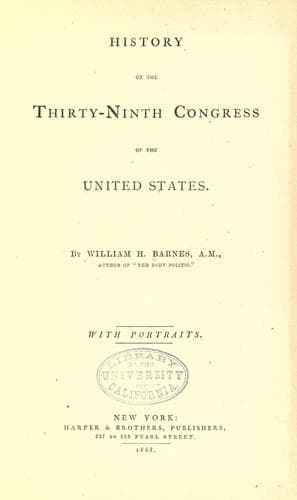
History of the Thirty-Ninth Congress of the United StatesBarnes, William Horatio
History
History of the Thirty-Ninth Congress of the United States
Barnes, William Horatio
United States -- Politics and government -- 1865-1869; United States. Congress (39th : 1865-1867)
"It is only when the offense does not happen to be within
the purview of the Federal law that the Federal courts are
to try and punish him under any other law; then resort is to
be had to 'the common law, as modified and changed' by State
legislation, 'so far as the same is not inconsistent with
the Constitution and laws of the United States.' So that
over this vast domain of criminal jurisprudence, provided by
each State for the protection of its own citizens, and for
the punishment of all persons who violate its criminal laws,
Federal law, wherever it can be made to apply, displaces
State law.
"The question here naturally arises, from what source
Congress derives the power to transfer to Federal tribunals
certain classes of cases embraced in this section. The
Constitution expressly declares that the judicial power of
the United States 'shall extend to all cases in law and
equity arising under this Constitution, the laws of the
United States, and treaties made, or which shall be made,
under their authority; to all cases affecting embassadors,
other public ministers, and consuls; to all cases of
admiralty and maritime jurisdiction; to controversies to
which the United States shall be a party; to controversies
between two or more States, between a State and citizens of
another State, between citizens of different States, between
citizens of the same State claiming land under grants of
different States, and between a State, or the citizens
thereof, and foreign States, citizens, or subjects.'
"Here the judicial power of the United States is expressly
set forth and defined; and the act of September 24, 1789,
establishing the judicial courts of the United States, in
conferring upon the Federal courts jurisdiction over cases
originating in State tribunals, is careful to confine them
to the classes enumerated in the above recited clause of the
Constitution. This section of the bill undoubtedly
comprehends case, and authorizes the exercise of powers that
are not, by the Constitution, within the jurisdiction of the
courts of the United States. To transfer them to those
courts would be an exercise of authority well calculated to
excite distrust and alarm on the part of all the States; for
the bill applies alike to all of them--as well to those that
have as to those that have not been engaged in rebellion.
Public-domain text, read in full here on John Shaqi.
Reviews
Reviews
No reviews yet
Be the first to share your thoughts on this work.
Elsewhere in the archive
Join the Discussion
Join the discussion
Sign in to leave a comment or review.
Sign InorCreate an account