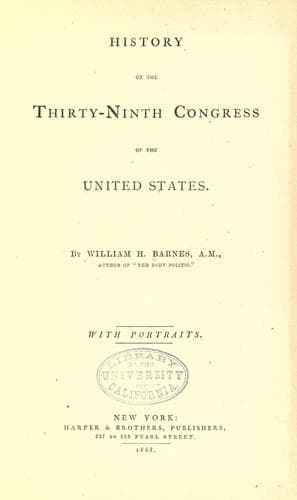
History of the Thirty-Ninth Congress of the United StatesBarnes, William Horatio
History
History of the Thirty-Ninth Congress of the United States
Barnes, William Horatio
United States -- Politics and government -- 1865-1869; United States. Congress (39th : 1865-1867)
"It may be assumed that this authority is incident to the
power granted to Congress by the Constitution, as recently
amended, to enforce, by appropriate legislation, the article
declaring that 'neither slavery nor involuntary servitude,
except as a punishment for crime whereof the party shall
have been duly convicted, shall exist within the United
States, or any place subject to their jurisdiction.' It can
not, however, be justly claimed that, with a view to the
enforcement of this article of the Constitution, there is,
at present, any necessity for the exercise of all the powers
which this bill confers.
"Slavery has been abolished, and, at present, nowhere exists
within the jurisdiction of the United States; nor has there
been, nor is it likely there will be, any attempt to revive
it by the people of the States. If, however, any such
attempt shall be made, it will then become the duty of the
General Government to exercise any and all incidental powers
necessary and proper to maintain inviolate this great
constitutional law of freedom.
"The fourth section of the bill provides that officers and
agents of the Freedmen's Bureau shall be empowered to make
arrests, and also that other officers may be specially
commissioned for that purpose by the President of the United
States. It also authorizes circuit courts of the United
States and the superior courts of the Territories to
appoint, without limitation, commissioners, who are to be
charged with the performance of _quasi_ judicial duties. The
fifth section empowers the commissioners so to be selected
by the courts to appoint, in writing, under their hands, one
or more suitable persons, from time to time, to execute
warrants and other processes described by the bill. These
numerous official agents are made to constitute a sort of
police, in addition to the military, and are authorized to
summon a _posse comitatus_ and even to call to their aid
such portion of the land and naval forces of the United
States, or of the militia, 'as may be necessary to the
performance of the duty with which they are charged.'
Public-domain text, read in full here on John Shaqi.
Reviews
Reviews
No reviews yet
Be the first to share your thoughts on this work.
Elsewhere in the archive
Join the Discussion
Join the discussion
Sign in to leave a comment or review.
Sign InorCreate an account