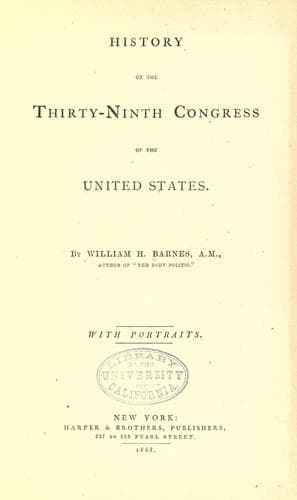
History of the Thirty-Ninth Congress of the United StatesBarnes, William Horatio
History
History of the Thirty-Ninth Congress of the United States
Barnes, William Horatio
United States -- Politics and government -- 1865-1869; United States. Congress (39th : 1865-1867)
Mr. Eliot, Chairman of the Committee on the Freedmen, and of the
Committee of Conference on the part of the House, at the request of a
member, thus explained the amendments proposed by the Senate: "The
first amendment which the Senate made to the bill, as it was passed by
the House, was simply an enlargement of one of the sections of the
House bill, which provided that the volunteer medical officers engaged
in the medical department of the bureau might be continued, inasmuch
as it was expected that the medical force of the regular army would be
speedily reduced to the minimum, and in that case all the regular
officers would be wanted in the service. It was therefore thought
right that there should be some force connected with the Bureau of
Refugees and Freedmen. The Senate enlarged the provisions of the House
bill by providing that officers of the volunteer service now on duty
might be continued as assistant commissioners and other officers, and
that the Secretary of War might fill vacancies until other officers
could be detailed from the regular army. That is the substance of the
first material amendment.
"The next amendment strikes out a portion of one of the sections of
the House bill, which related to the officers who serve as medical
officers of the bureau, because it was provided for in the amendment
to which I have just referred.
"The next amendment strikes out from the House bill the section which
set apart, reserved from sale, a million acres of land in the Gulf
States. It may perhaps be recollected that when the bill was reported
from the committee, I stated that, in case the bill which the House
had then passed, and which was known as the Homestead Bill, and which
was then before the Senate, should become a law, this section of the
bill would not be wanted. The bill referred to has become a law, and
this section five, providing for that reservation, has, therefore,
been stricken from the bill.
Public-domain text, read in full here on John Shaqi.
Reviews
Reviews
No reviews yet
Be the first to share your thoughts on this work.
Elsewhere in the archive
Join the Discussion
Join the discussion
Sign in to leave a comment or review.
Sign InorCreate an account