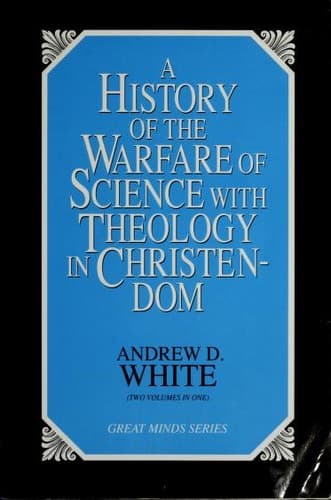
History of the Warfare of Science with Theology in ChristendomWhite, Andrew Dickson
Religion
History of the Warfare of Science with Theology in Christendom
White, Andrew Dickson
Religion and science -- History
For generations men in various parts of the world had been making
careful observations on these strange bodies. As far back as the time
when Luther and Melanchthon and Zwingli were plunged into alarm by
various comets from 1531 to 1539, Peter Apian kept his head sufficiently
cool to make scientific notes of their paths through the heavens. A
little later, when the great comet of 1556 scared popes, emperors, and
reformers alike, such men as Fabricius at Vienna and Heller at Nuremberg
quietly observed its path. In vain did men like Dieterich and Heerbrand
and Celich from various parts of Germany denounce such observations and
investigations as impious; they were steadily continued, and in 1577
came the first which led to the distinct foundation of the modern
doctrine. In that year appeared a comet which again plunged Europe into
alarm. In every European country this alarm was strong, but in Germany
strongest of all. The churches were filled with terror-stricken
multitudes. Celich preaching at Magdeburg was echoed by Heerbrand
preaching at Tubingen, and both these from thousands of other pulpits,
Catholic and Protestant, throughout Europe. In the midst of all this
din and outcry a few men quietly but steadily observed the monster; and
Tycho Brahe announced, as the result, that its path lay farther from
the earth than the orbit of the moon. Another great astronomical genius,
Kepler, confirmed this. This distinct beginning of the new doctrine was
bitterly opposed by theologians; they denounced it as one of the evil
results of that scientific meddling with the designs of Providence
against which they had so long declaimed in pulpits and professors'
chairs; they even brought forward some astronomers ambitious or
wrong-headed enough to testify that Tycho and Kepler were in error.(119)
(119) See Madler, Himmelskunde, vol. i, pp. 181, 197; also Wolf, Gesch.
d. Astronomie, and Janssen, Gesch. d. deutschen Volkes, vol. v, p. 350.
Heerbrand's sermon, cited above, is a good specimen of the theologic
attitude. See Pingre, vol. ii, p. 81.
Nothing could be more natural than such opposition; for this simple
announcement by Tycho Brahe began a new era. It shook the very
foundation of cometary superstition. The Aristotelian view, developed by
the theologians, was that what lies within the moon's orbit appertains
to the earth and is essentially transitory and evil, while what lies
beyond it belongs to the heavens and is permanent, regular, and pure.
Tycho Brahe and Kepler, therefore, having by means of scientific
observation and thought taken comets out of the category of meteors and
appearances in the neighbourhood of the earth, and placed them among the
heavenly bodies, dealt a blow at the very foundations of the theological
argument, and gave a great impulse to the idea that comets are
themselves heavenly bodies moving regularly and in obedience to law.
IV. THEOLOGICAL EFFORTS AT COMPROMISE.--THE FINAL VICTORY OF SCIENCE.
Public-domain text, read in full here on John Shaqi.
Reviews
Reviews
No reviews yet
Be the first to share your thoughts on this work.
Elsewhere in the archive
Join the Discussion
Join the discussion
Sign in to leave a comment or review.
Sign InorCreate an account