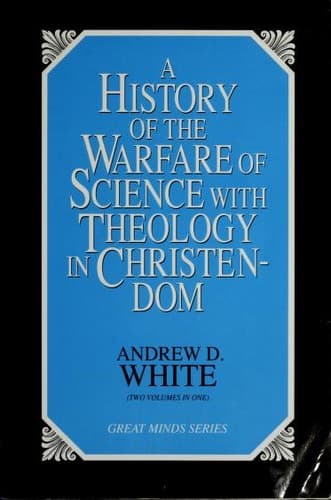
History of the Warfare of Science with Theology in ChristendomWhite, Andrew Dickson
Religion
History of the Warfare of Science with Theology in Christendom
White, Andrew Dickson
Religion and science -- History
Still the struggle was not ended, and, a few years later, a forlorn hope
was led in England by Granville Penn.
His fundamental thesis was that "our globe has undergone only two
revolutions, the Creation and the Deluge, and both by the immediate fiat
of the Almighty"; he insisted that the Creation took place in exactly
six days of ordinary time, each made up of "the evening and the
morning"; and he ended with a piece of that peculiar presumption so
familiar to the world, by calling on Cuvier and all other geologists to
"ask for the old paths and walk therein until they shall simplify their
system and reduce their numerous revolutions to the two events or epochs
only--the six days of Creation and the Deluge."(163) The geologists
showed no disposition to yield to this peremptory summons; on the
contrary, the President of the British Geological Society, and even so
eminent a churchman and geologist as Dean Buckland, soon acknowledged
that facts obliged them to give up the theory that the fossils of the
coal measures were deposited at the Deluge of Noah, and to deny that the
Deluge was universal.
(163) See the Works of Granville Penn, vol. ii, p. 273.
The defection of Buckland was especially felt by the orthodox party. His
ability, honesty, and loyalty to his profession, as well as his position
as Canon of Christ Church and Professor of Geology at Oxford, gave him
great authority, which he exerted to the utmost in soothing his brother
ecclesiastics. In his inaugural lecture he had laboured to show that
geology confirmed the accounts of Creation and the Flood as given
in Genesis, and in 1823, after his cave explorations had revealed
overwhelming evidences of the vast antiquity of the earth, he had still
clung to the Flood theory in his Reliquiae Diluvianae.
This had not, indeed, fully satisfied the anti-scientific party, but as
a rule their attacks upon him took the form not so much of abuse as of
humorous disparagement. An epigram by Shuttleworth, afterward Bishop
of Chichester, in imitation of Pope's famous lines upon Newton, ran as
follows:
"Some doubts were once expressed about the Flood: Buckland arose, and
all was clear as mud."
On his leaving Oxford for a journey to southern Europe, Dean Gaisford
was heard to exclaim: "Well, Buckland is gone to Italy; so, thank God,
we shall have no more of this geology!"
Public-domain text, read in full here on John Shaqi.
Reviews
Reviews
No reviews yet
Be the first to share your thoughts on this work.
Elsewhere in the archive
Join the Discussion
Join the discussion
Sign in to leave a comment or review.
Sign InorCreate an account