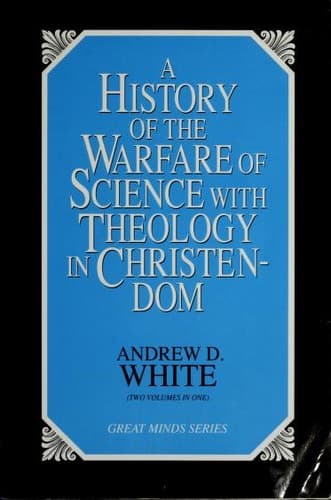
History of the Warfare of Science with Theology in ChristendomWhite, Andrew Dickson
Religion
History of the Warfare of Science with Theology in Christendom
White, Andrew Dickson
Religion and science -- History
The next point developed in this theologic evolution had reference to
the MATTER of which the universe was made, and it was decided by an
overwhelming majority that no material substance existed before the
creation of the material universe--that "God created everything out of
nothing." Some venturesome thinkers, basing their reasoning upon the
first verses of Genesis, hinted at a different view--namely, that the
mass, "without form and void," existed before the universe; but this
doctrine was soon swept out of sight. The vast majority of the fathers
were explicit on this point. Tertullian especially was very severe
against those who took any other view than that generally accepted as
orthodox: he declared that, if there had been any pre-existing matter
out of which the world was formed, Scripture would have mentioned it;
that by not mentioning it God has given us a clear proof that there
was no such thing; and, after a manner not unknown in other theological
controversies, he threatens Hermogenes, who takes the opposite view,
with the woe which impends on all who add to or take away from the
written word.
St. Augustine, who showed signs of a belief in a pre-existence of
matter, made his peace with the prevailing belief by the simple
reasoning that, "although the world has been made of some material, that
very same material must have been made out of nothing."
In the wake of these great men the universal Church steadily followed.
The Fourth Lateran Council declared that God created everything out
of nothing; and at the present hour the vast majority of the
faithful--whether Catholic or Protestant--are taught the same doctrine;
on this point the syllabus of Pius IX and the Westminster Catechism
fully agree.(3)
(3) For Tertullian, see Tertullian against Hermogenes, chaps. xx and
xxii; for St. Augustine regarding "creation from nothing," see the De
Genesi contra Manichaeos, lib, i, cap. vi; for St. Ambrose, see the
Hexameron, lib, i, cap iv; for the decree of the Fourth Lateran Council,
and the view received in the Church to-day, see the article Creation in
Addis and Arnold's Catholic Dictionary.
Having thus disposed of the manner and matter of creation, the next
subject taken up by theologians was the TIME required for the great
work.
Public-domain text, read in full here on John Shaqi.
Reviews
Reviews
No reviews yet
Be the first to share your thoughts on this work.
Join the Discussion
Join the discussion
Sign in to leave a comment or review.
Sign InorCreate an account