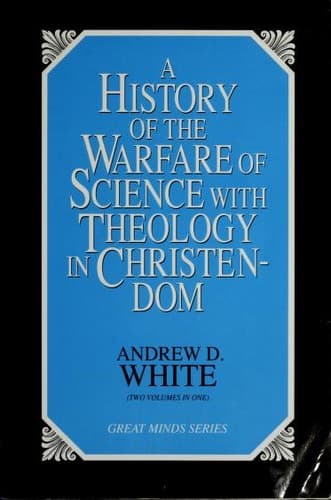
History of the Warfare of Science with Theology in ChristendomWhite, Andrew Dickson
Religion
History of the Warfare of Science with Theology in Christendom
White, Andrew Dickson
Religion and science -- History
Here came a difficulty. The first of the two accounts given in Genesis
extended the creative operation through six days, each of an evening
and a morning, with much explicit detail regarding the progress made in
each. But the second account spoke of "THE DAY" in which "the Lord God
made the earth and the heavens." The explicitness of the first account
and its naturalness to the minds of the great mass of early theologians
gave it at first a decided advantage; but Jewish thinkers, like Philo,
and Christian thinkers, like Origen, forming higher conceptions of
the Creator and his work, were not content with this, and by them was
launched upon the troubled sea of Christian theology the idea that the
creation was instantaneous, this idea being strengthened not only by the
second of the Genesis legends, but by the great text, "He spake, and
it was done; he commanded, and it stood fast"--or, as it appears in
the Vulgate and in most translations, "He spake, and they were made; he
commanded, and they were created."
As a result, it began to be held that the safe and proper course was to
believe literally BOTH statements; that in some mysterious manner God
created the universe in six days, and yet brought it all into existence
in a moment. In spite of the outcries of sundry great theologians,
like Ephrem Syrus, that the universe was created in exactly six days of
twenty-four hours each, this compromise was promoted by St. Athanasius
and St. Basil in the East, and by St. Augustine and St. Hilary in the
West.
Serious difficulties were found in reconciling these two views, which
to the natural mind seem absolutely contradictory; but by ingenious
manipulation of texts, by dexterous play upon phrases, and by the
abundant use of metaphysics to dissolve away facts, a reconciliation
was effected, and men came at least to believe that they believed in
a creation of the universe instantaneous and at the same time extended
through six days.(4)
(4) For Origen, see his Contra Celsum, cap xxxvi, xxxvii; also his
De Principibus, cap. v; for St. Augustine, see his De Genesi conta
Manichaeos and De Genesi ad Litteram, passim; for Athanasius, see his
Discourses against the Arians, ii, 48,49.
Public-domain text, read in full here on John Shaqi.
Reviews
Reviews
No reviews yet
Be the first to share your thoughts on this work.
Join the Discussion
Join the discussion
Sign in to leave a comment or review.
Sign InorCreate an account