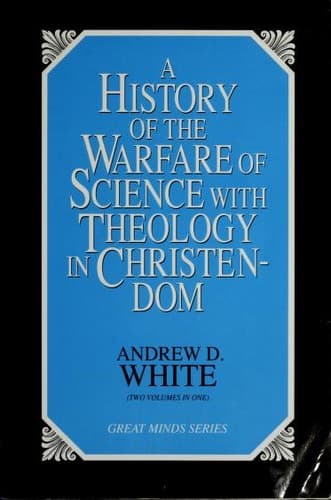
History of the Warfare of Science with Theology in ChristendomWhite, Andrew Dickson
Religion
History of the Warfare of Science with Theology in Christendom
White, Andrew Dickson
Religion and science -- History
This view, growing out of the myths, legends, and theologies of earlier
peoples, we also find embodied in the sacred tradition of the Jews,
and especially in one of the documents which form the impressive poem
beginning the books attributed to Moses. As to the Christian Church, no
word of its Blessed Founder indicates that it was committed by him to
this theory, or that he even thought it worthy of his attention. How,
like so many other dogmas never dreamed of by Jesus of Nazareth and
those who knew him best, it was developed, it does not lie within the
province of this chapter to point out; nor is it worth our while to
dwell upon its evolution in the early Church, in the Middle Ages, at the
Reformation, and in various branches of the Protestant Church: suffice
it that, though among English-speaking nations by far the most important
influence in its favour has come from Milton's inspiration rather than
from that of older sacred books, no doctrine has been more universally
accepted, "always, everywhere, and by all," from the earliest fathers of
the Church down to the present hour.
On the other hand appeared at an early period the opposite view--that
mankind, instead of having fallen from a high intellectual, moral, and
religious condition, has slowly risen from low and brutal beginnings.
In Greece, among the philosophers contemporary with Socrates, we find
Critias depicting a rise of man, from a time when he was beastlike
and lawless, through a period when laws were developed, to a time
when morality received enforcement from religion; but among all the
statements of this theory the most noteworthy is that given by Lucretius
in his great poem on The Nature of Things. Despite its errors, it
remains among the most remarkable examples of prophetic insight in
the history of our race. The inspiration of Lucretius gave him
almost miraculous glimpses of truth; his view of the development
of civilization from the rudest beginnings to the height of its
achievements is a wonderful growth, rooted in observation and thought,
branching forth into a multitude of striking facts and fancies; and
among these is the statement regarding the sequence of inventions:
"Man's earliest arms were fingers, teeth, and nails, And stones and
fragments from the branching woods; Then copper next; and last, as
latest traced, The tyrant, iron."
Thus did the poet prophesy one of the most fruitful achievements of
modern science: the discovery of that series of epochs which has been so
carefully studied in our century.
Very striking, also, is the statement of Horace, though his idea is
evidently derived from Lucretius. He dwells upon man's first condition
on earth as low and bestial, and pictures him lurking in caves,
progressing from the use of his fists and nails, first to clubs, then
to arms which he had learned to forge, and, finally, to the invention of
the names of things, to literature, and to laws.(189)
Public-domain text, read in full here on John Shaqi.
Reviews
Reviews
No reviews yet
Be the first to share your thoughts on this work.
Elsewhere in the archive
Join the Discussion
Join the discussion
Sign in to leave a comment or review.
Sign InorCreate an account