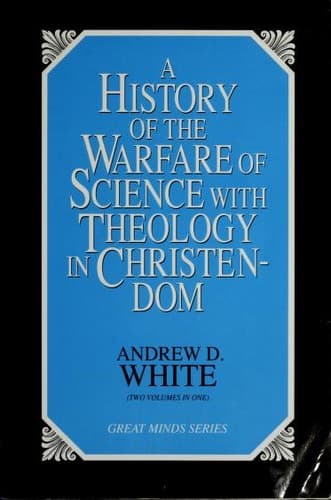
History of the Warfare of Science with Theology in Christendom — John Shaqi
History of the Warfare of Science with Theology in ChristendomWhite, Andrew Dickson
Religion
History of the Warfare of Science with Theology in Christendom
White, Andrew Dickson
Religion and science -- History
St. Hilary of Poictiers reconciled the two conceptions as follows: "For,
although according to Moses there is an appearance of regular order
in the fixing of the firmament, the laying bare of the dry land, the
gathering together of the waters, the formation of the heavenly bodies,
and the arising of living things from land and water, yet the creation
of the heavens, earth, and other elements is seen to be the work of a
single moment."
St. Thomas Aquinas drew from St. Augustine a subtle distinction which
for ages eased the difficulties in the case: he taught in effect that
God created the substance of things in a moment, but gave to the work of
separating, shaping, and adorning this creation, six days.(5)
(5) For Philo Judaeus, see his Creation of the World, chap. iii; for
St. Augustine on the powers of numbers in creation, see his De Genesi ad
Litteram iv, chap. ii; for Peter Lombard, see the Sententiae, lib. ii,
dist. xv, 5; and for Hugo of St. Victor, see De Sacrementis, lib i, pars
i; also, Annotat, Elucidat in Pentateuchum, cap. v, vi, vii; for St.
Hilary, see De Trinitate, lib. xii; for St. Thomas Aquinas, see his
Summa Theologica, quest lxxxiv, arts. i and ii; the passage in the
Nuremberg Chronicle, 1493, is in fol. iii; for Vousset, see his Discours
sur l'Histoire Universelle; for the sacredness of the number seven among
the Babylonians, see especially Schrader, Die Keilinschriften und das
Alte Testament, pp. 21,22; also George Smith et al.; for general ideas
on the occult powers of various numbers, especially the number seven,
and the influence of these ideas on theology and science, see my chapter
on astronomy. As to medieaval ideas on the same subject, see Detzel,
Christliche Ikonographie, Frieburg, 1894, pp. 44 and following.
The early reformers accepted and developed the same view, and Luther
especially showed himself equal to the occasion. With his usual boldness
he declared, first, that Moses "spoke properly and plainly, and neither
allegorically nor figuratively," and that therefore "the world with all
creatures was created in six days." And he then goes on to show how, by
a great miracle, the whole creation was also instantaneous.
Melanchthon also insisted that the universe was created out of nothing
and in a mysterious way, both in an instant and in six days, citing the
text: "He spake, and they were made."
Calvin opposed the idea of an instantaneous creation, and laid especial
stress on the creation in six days: having called attention to the
fact that the biblical chronology shows the world to be not quite
six thousand years old and that it is now near its end, he says that
"creation was extended through six days that it might not be tedious for
us to occupy the whole of life in the consideration of it."
Public-domain text, read in full here on John Shaqi.
Reviews
Reviews
No reviews yet
Be the first to share your thoughts on this work.
Join the Discussion
Join the discussion
Sign in to leave a comment or review.
Sign InorCreate an account