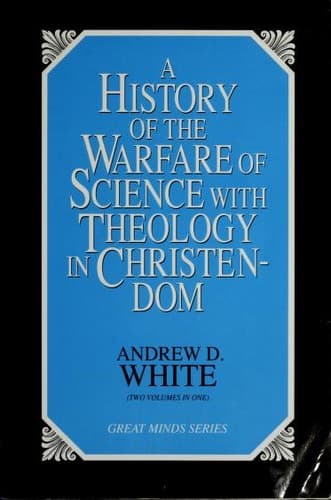
History of the Warfare of Science with Theology in ChristendomWhite, Andrew Dickson
Religion
History of the Warfare of Science with Theology in Christendom
White, Andrew Dickson
Religion and science -- History
Some of the efforts to reconcile these two accounts were so fruitful as
to deserve especial record. The fathers, Eastern and Western, developed
out of the double account in Genesis, and the indications in the Psalms,
the Proverbs, and the book of Job, a vast mass of sacred science bearing
upon this point. As regards the whole work of creation, stress was laid
upon certain occult powers in numerals. Philo Judaeus, while believing
in an instantaneous creation, had also declared that the world was
created in six days because "of all numbers six is the most productive";
he had explained the creation of the heavenly bodies on the fourth day
by "the harmony of the number four"; of the animals on the fifth day
by the five senses; of man on the sixth day by the same virtues in the
number six which had caused it to be set as a limit to the creative
work; and, greatest of all, the rest on the seventh day by the vast mass
of mysterious virtues in the number seven.
St. Jerome held that the reason why God did not pronounce the work of
the second day "good" is to be found in the fact that there is something
essentially evil in the number two, and this was echoed centuries
afterward, afar off in Britain, by Bede.
St. Augustine brought this view to bear upon the Church in the following
statement: "There are three classes of numbers--the more than perfect,
the perfect, and the less than perfect, according as the sum of them
is greater than, equal to, or less than the original number. Six is the
first perfect number: wherefore we must not say that six is a perfect
number because God finished all his works in six days, but that God
finished all his works in six days because six is a perfect number."
Reasoning of this sort echoed along through the mediaeval Church until
a year after the discovery of America, when the Nuremberg Chronicle
re-echoed it as follows: "The creation of things is explained by the
number six, the parts of which, one, two, and three, assume the form of
a triangle."
This view of the creation of the universe as instantaneous and also as
in six days, each made up of an evening and a morning, became virtually
universal. Peter Lombard and Hugo of St. Victor, authorities of vast
weight, gave it their sanction in the twelfth century, and impressed it
for ages upon the mind of the Church.
Both these lines of speculation--as to the creation of everything out
of nothing, and the reconciling of the instantaneous creation of the
universe with its creation in six days--were still further developed by
other great thinkers of the Middle Ages.
Public-domain text, read in full here on John Shaqi.
Reviews
Reviews
No reviews yet
Be the first to share your thoughts on this work.
Join the Discussion
Join the discussion
Sign in to leave a comment or review.
Sign InorCreate an account