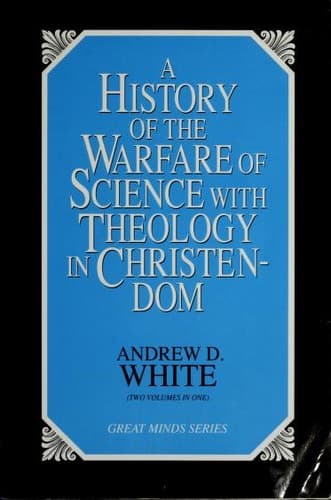
History of the Warfare of Science with Theology in Christendom — John Shaqi
History of the Warfare of Science with Theology in ChristendomWhite, Andrew Dickson
Religion
History of the Warfare of Science with Theology in Christendom
White, Andrew Dickson
Religion and science -- History
Of this belief we find survivals among the early fathers, and especially
in St. Ambrose. In his work on creation he tells us: "We must remember
that the light of day is one thing and the light of the sun, moon,
and stars another--the sun by his rays appearing to add lustre to
the daylight. For before sunrise the day dawns, but is not in full
refulgence, for the sun adds still further to its splendour." This
idea became one of the "treasures of sacred knowledge committed to the
Church," and was faithfully received by the Middle Ages. The medieval
mysteries and miracle plays give curious evidences of this: In a
performance of the creation, when God separates light from darkness, the
stage direction is, "Now a painted cloth is to be exhibited, one half
black and the other half white." It was also given more permanent form.
In the mosaics of San Marco at Venice, in the frescoes of the Baptistery
at Florence and of the Church of St. Francis at Assisi, and in the altar
carving at Salerno, we find a striking realization of it--the Creator
placing in the heavens two disks or living figures of equal size, each
suitably coloured or inscribed to show that one represents light and the
other darkness. This conception was without doubt that of the person or
persons who compiled from the Chaldean and other earlier statements the
accounts of the creation in the first of our sacred books.(8)
(8) For scriptural indications of the independent existence of light and
darkness, compare with the first verses of the chapter of Genesis such
passages as Job xxxviii, 19,24; for the general prevalence of this early
view, see Lukas, Kosmogonie, pp. 31, 33, 41, 74, and passim; for the
view of St. Ambrose regarding the creation of light and of the sun, see
his Hexameron, lib. 4, cap. iii; for an excellent general statement,
see Huxley, Mr. Gladstone and Genesis, in the Nineteenth Century, 1886,
reprinted in his Essays on Controverted Questions, London, 1892,
note, pp. 126 et seq.; for the acceptance in the miracle plays of the
scriptural idea of light and darkness as independent creations, see
Wright, Essays on Archeological Subjects, vol. ii, p.178; for an
account, with illustrations, of the mosaics, etc., representing this
idea, see Tikkanen, Die Genesis-mosaiken von San Marco, Helsingfors,
1889, p. 14 and 16 of the text and Plates I and II. Very naively the
Salerno carver, not wishing to colour the ivory which he wrought, has
inscribed on one disk the word "LUX" and on the other "NOX." See also
Didron, Iconographie, p. 482.
Public-domain text, read in full here on John Shaqi.
Reviews
Reviews
No reviews yet
Be the first to share your thoughts on this work.
Join the Discussion
Join the discussion
Sign in to leave a comment or review.
Sign InorCreate an account