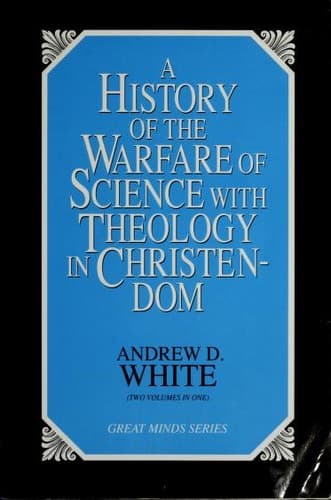
History of the Warfare of Science with Theology in ChristendomWhite, Andrew Dickson
Religion
History of the Warfare of Science with Theology in Christendom
White, Andrew Dickson
Religion and science -- History
First of those who should be mentioned with reverence as beginning to
develop again that current of Greek thought which the system drawn
from our sacred books by the fathers and doctors of the Church had
interrupted for more than a thousand years, was Giordano Bruno. His
utterances were indeed vague and enigmatical, but this fault may well be
forgiven him, for he saw but too clearly what must be his reward for
any more open statements. His reward indeed came--even for his faulty
utterances--when, toward the end of the nineteenth century, thoughtful
men from all parts of the world united in erecting his statue on the
spot where he had been burned by the Roman Inquisition nearly three
hundred years before.
After Bruno's death, during the first half of the seventeenth century,
Descartes seemed about to take the leadership of human thought: his
theories, however superseded now, gave a great impulse to investigation
then. His genius in promoting an evolution doctrine as regards the
mechanical formation of the solar system was great, and his mode of
thought strengthened the current of evolutionary doctrine generally; but
his constant dread of persecution, both from Catholics and Protestants,
led him steadily to veil his thoughts and even to suppress them. The
execution of Bruno had occurred in his childhood, and in the midst of
his career he had watched the Galileo struggle in all its stages. He had
seen his own works condemned by university after university under the
direction of theologians, and placed upon the Roman Index. Although
he gave new and striking arguments to prove the existence of God, and
humbled himself before the Jesuits, he was condemned by Catholics and
Protestants alike. Since Roger Bacon, perhaps, no great thinker had been
so completely abased and thwarted by theological oppression.
Near the close of the same century another great thinker, Leibnitz,
though not propounding any full doctrine on evolution, gave it an
impulse by suggesting a view contrary to the sacrosanct belief in the
immutability of species--that is, to the pious doctrine that every
species in the animal kingdom now exists as it left the hands of the
Creator, the naming process by Adam, and the door of Noah's ark.
His punishment at the hands of the Church came a few years later, when,
in 1712, the Jesuits defeated his attempt to found an Academy of Science
at Vienna. The imperial authorities covered him with honours, but the
priests--ruling in the confessionals and pulpits--would not allow
him the privilege of aiding his fellow-men to ascertain God's truths
revealed in Nature.
Public-domain text, read in full here on John Shaqi.
Reviews
Reviews
No reviews yet
Be the first to share your thoughts on this work.
Elsewhere in the archive
Join the Discussion
Join the discussion
Sign in to leave a comment or review.
Sign InorCreate an account