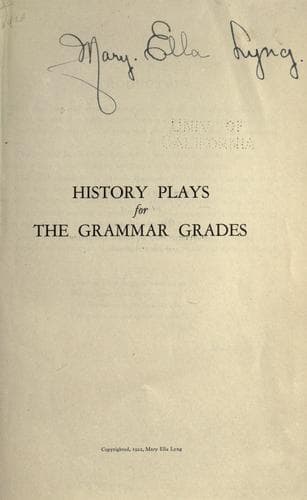
History Plays for the Grammar GradesLyng, Mary Ella
History
History Plays for the Grammar Grades
Lyng, Mary Ella
Children's plays; Historical drama
DANIEL'S SPEECH: God made the woodchuck. He made him to live in the
bright sunlight and the pure air. He made him to enjoy the free air
and the good woods. The woodchuck is not a fierce animal like the wolf
or the fox. He lives in quiet and peace. A hole in the side of a hill
and a little food is all that he wants. He has harmed nothing but a
few plants which he ate to keep himself alive. The woodchuck has a
right to life, to food, to liberty, for God gave them to him.
Look at his soft pleading eyes. See him tremble with fear. He cannot
speak for himself and this is the only way he can plead for the life
that is so sweet to him. Shall we be so cruel as to kill him? Shall
we be so selfish as to take from him the life that God gave him?
FATHER: Ezekiel, Ezekiel, let that woodchuck go!
ACT II.
INTRODUCTION: WEBSTER.
One day in spring, Daniel Webster's father took Daniel to Exeter
Academy to prepare for college. All the boys laughed at his rustic
dress and manners.
He finally entered Dartmouth College at the age of fifteen. He was the
best student there. All the students liked him. At the age of eighteen
he gave a Fourth of July oration in his college town. After he had
finished at Dartmouth, he taught school in order to help his parents
send his older brother to school. Later, he entered Christopher Gore's
law office. He studied very hard and won name and fame as a lawyer.
The approach of the war of 1812 brought him into politics.
He was elected to Congress and took his seat in 1813.
INTRODUCTION: HENRY CLAY.
Henry Clay was born in Virginia at the year of Burgoyne's surrender,
1777. His father died when he was four years old. Little Henry lived
near the "Slashes" the name given to a low flat region and went to
school in a log cabin. He worked on a farm to do his share in the
support of the family. Sometimes he would be seen barefooted behind
the plow or else riding a horse to mill. From this he was called the
"Mill boy of the Slashes." At fourteen he was a clerk in a store but
he was made for better use.
He was put in the office of a famous lawyer who was a clerk in one
of Virginia's courts. He went to Richmond and studied law there. He
formed a debating club and was made leader. From here he went to
Lexington. There his rise in law was rapid, his fame grew and he was
known as a lawyer who seldom lost his case.
He was elected to the House of Representatives and was made speaker.
As speaker he helped to bring on the War of 1812.
INTRODUCTION: JOHN C. CALHOUN.
Public-domain text, read in full here on John Shaqi.
Reviews
Reviews
No reviews yet
Be the first to share your thoughts on this work.
Join the Discussion
Join the discussion
Sign in to leave a comment or review.
Sign InorCreate an account