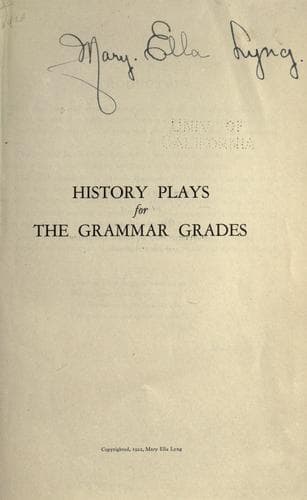
History Plays for the Grammar GradesLyng, Mary Ella
History
History Plays for the Grammar Grades
Lyng, Mary Ella
Children's plays; Historical drama
Calhoun was born in the same year as Webster, 1782. He was born in
South Carolina. His parents were Scotch-Irish. He learned more from
the woods than he did from books and filled his memory before people
could fill it. At the age of eighteen he began to prepare for college
with the aid of his brother-in-law, a Presbyterian minister. Two years
later he entered Yale College, studied hard and soon graduated with
much honor. He studied law for three years, a year and a half in his
own state and a year and a half in Connecticut. He began to practice
law in South Carolina. He did not have much success. Perhaps the law
was too dry for him or perhaps because he was soon to be elected to
Congress.
In 1811 he was married and elected to Congress.
Henry Clay (Speaker) immediately put Calhoun on an important
committee.
The next act will be John C. Calhoun, Daniel Webster and Henry Clay
speaking of the war of 1812.
CLAY (speaker): Members of Congress and fellow citizens: England has
been at war with France for a number of years. France under Napoleon
has secured a large part of Europe. England has tried in various ways
to injure France by proclaiming that no ships of any nation shall
trade with France.
Napoleon retorted, issuing a decree that no ships shall trade with
Europe and these laws hurt American commerce. Shall we stand this or
demand our rights?
Gentlemen, I say we must fight. On to Canada!
MEMBER OF HOUSE: I think we should be very careful about going to war
with Great Britain. She has a thousand war vessels, while the United
States has only ten or twelve first-class vessels.
MEMBER OF CONGRESS: England's troops are numerous, well drilled and
have had much experience. Our troops are few and poorly disciplined
and unused to war. I think, all matters in dispute could be arranged
without fighting.
MEMBER OF CONGRESS: We would make a great mistake to fight England
and France at the same time.
WEBSTER: The British in taking our men have made it a practice to stop
American merchant ships and seize the best sailors. They claim these
men are British citizens and could be rightfully seized. Whenever they
see a fine looking seaman, they say: "You are an Englishman, we will
take you!" We must fight with the navy. If the war must be continued
go to the ocean. There the united wishes and exertions of the nation
will go with you. Even our party divisions end at the water's edge.
MR. CALHOUN: We have tried in various ways to induce England and
France to change these laws. These are not the only grievances we
have. England has a large navy. She needs many sailors. When our
ships were in her parts, she has seized our men and forced them on
her ships. Is this right? Must we stand such treatment? No! So we
call forth the patriotism and resources of our country to help us.
_End of Act II._
ACT III
INTRODUCTION:
Public-domain text, read in full here on John Shaqi.
Reviews
Reviews
No reviews yet
Be the first to share your thoughts on this work.
Join the Discussion
Join the discussion
Sign in to leave a comment or review.
Sign InorCreate an account