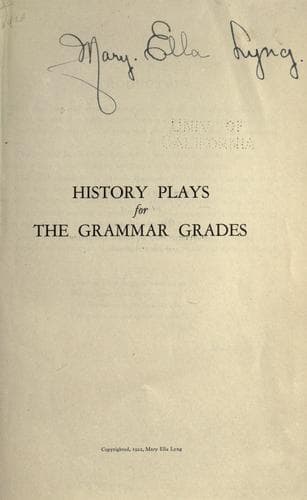
History Plays for the Grammar GradesLyng, Mary Ella
History
History Plays for the Grammar Grades
Lyng, Mary Ella
Children's plays; Historical drama
Gentlemen, there has been a nomination. (People in office crowd around
him and talk). Mr. Seward (disappointment on faces of Lincoln and
men) Mr. Seward is the second name on the list. (Jumps upon chair and
exclaims). Three cheers for Abraham Lincoln, the next president of the
United States.
_End of Act III._
ACT IV.
INTRODUCTION:
Abraham Lincoln was elected President. Soon after war broke out
between the North and the South. Lincoln declared that the war was not
to free the slaves but to save the Union. Lincoln soon saw that it was
time to free the slaves, so he signed the Proclamation of
Emancipation.
This act linked the name of Lincoln with one of the greatest acts in
history.
The last act will be President Lincoln signing the Proclamation of
Emancipation.
(Lincoln sits at desk. Two men are showing him papers. One enters
and says: "Mr. Lincoln, here is Mr. Seward with the
Proclamation." Enter Seward and several others.)
MR. SEWARD: I have brought you the Proclamation to sign, Mr.
President.
(Lincoln takes paper, reads it over, takes up pen, tries to
write, drops pen several times.)
MR. SEWARD: What is the matter, Mr. Lincoln?
MR. LINCOLN: I have been shaking hands since nine o'clock this morning
and my right hand is almost paralyzed. If my name ever goes down into
history it will be for this act and my whole soul is in it. If my hand
trembles as I sign this document, the ones who examine it will say--he
hesitated.
GRANT AND LEE
INTRODUCTION:
Ulysses S. Grant was born in Ohio, April 27, 1822. His father was a
tanner. He was brought up for farm work. Later went to West Point from
where he graduated in 1843. He distinguished himself in the Mexican
War. He resigned from the army in 1854, tried various kinds of
business in St. Louis and Galena, Illinois. On the day after the fall
of Sumter, Grant made up his mind to return to the army. In August
1861 he became a brigadier general. From 1861 to 1863 his name was
connected with most of the successful operations in the West, till
Lincoln said of him, "I can't spare this man. He fights." His greatest
characteristic was his indomitable grit.
The first act will be Grant sending his answer to General Buckner at
the capture of Fort Donelson.
ACT I.
(Grant at desk, writing and looking over maps. Men at wall
looking over maps. Officer speaks to General Grant.)
OFFICER: Two soldiers from General Buckner await outside, General
Grant.
GRANT: Show them in.
(Enter soldiers with Union man. Soldier salutes).
SOLDIER: General Grant, General Buckner wishes to know on what terms
you will consider the surrender of Fort Donelson.
GRANT: No terms except an unconditional and immediate surrender can
be accepted. I propose to move immediately upon your works.
SOLDIER: Your answer will be given to General Buckner. Good bye,
General Grant. (Salute).
GRANT: (Salute). Goodbye.
ROBERT E. LEE
INTRODUCTION:
Public-domain text, read in full here on John Shaqi.
Reviews
Reviews
No reviews yet
Be the first to share your thoughts on this work.
Join the Discussion
Join the discussion
Sign in to leave a comment or review.
Sign InorCreate an account