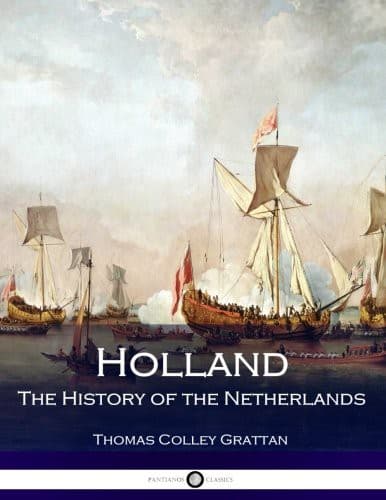
Holland: The History of the NetherlandsGrattan, Thomas Colley
History
Holland: The History of the Netherlands
Grattan, Thomas Colley
Netherlands -- History
Rapid Organization of Holland--The Constitution formed--Accepted by
the People--Objections made to it by some Individuals--Inauguration
of the Prince-Sovereign--Belgium is occupied by the Allies--Treaty
of Paris--Treaty of London--Formation of the Kingdom of the
Netherlands--Basis of the Government--Relative Character and
Situation of Holland and Belgium--The Prince-Sovereign of Holland
arrives in Belgium as Governor-General--The fundamental Law--Report
of the Commissioners by whom it was framed--Public Feeling in
Holland, and in Belgium--The Emperor Napoleon invades France,
and Belgium--The Prince of Orange takes the Field--The Duke of
Wellington--Prince Blucher--Battle of Ligny--Battle of Quatre
Bras--Battle of Waterloo--Anecdote of the Prince of Orange, who
is wounded--Inauguration of the King.
SUPPLEMENTARY CHAPTER (A.D. 1810--1899).
LIST OF ILLUSTRATIONS
HOLLAND
The Duke of Alva Deposes Margaret of Parma.
Storming the Barricades at Brussels During the Revolution of 1848.
William the Silent of Orange.
A Holland Beauty.
CHAPTER I
FROM THE INVASION OF THE NETHERLANDS BY THE ROMANS TO THE INVASION
BY THE SALIAN FRANKS
B.C. 50--A.D. 200
The Netherlands form a kingdom of moderate extent, situated on
the borders of the ocean, opposite to the southeast coast of
England, and stretching from the frontiers of France to those
of Hanover. The country is principally composed of low and humid
grounds, presenting a vast plain, irrigated by the waters from
all those neighboring states which are traversed by the Rhine,
the Meuse, and the Scheldt. This plain, gradually rising toward
its eastern and southern extremities, blends on the one hand
with Prussia, and on the other with France. Having, therefore,
no natural or strongly marked limits on those sides, the extent
of the kingdom could only be determined by convention; and it must
be at all times subject to the arbitrary and varying influence
of European policy. Its greatest length, from north to south, is
about two hundred and twenty English miles; and its breadth,
from east to west, is nearly one hundred and forty.
Public-domain text, read in full here on John Shaqi.
Reviews
Reviews
No reviews yet
Be the first to share your thoughts on this work.
Join the Discussion
Join the discussion
Sign in to leave a comment or review.
Sign InorCreate an account