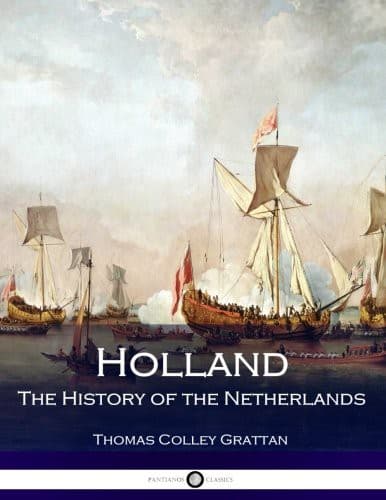
Holland: The History of the NetherlandsGrattan, Thomas Colley
History
Holland: The History of the Netherlands
Grattan, Thomas Colley
Netherlands -- History
Two distinct kinds of men inhabit this kingdom. The one occupying
the valleys of the Meuse and the Scheldt, and the high grounds
bordering on France, speak a dialect of the language of that
country, and evidently belong to the Gallic race. They are called
Walloons, and are distinguished from the others by many peculiar
qualities. Their most prominent characteristic is a propensity
for war, and their principal source of subsistence the working
of their mines. They form nearly one-fourth of the population of
the whole kingdom, or about one million three hundred thousand
persons. All the rest of the nation speak Low German, in its
modifications of Dutch and Flemish; and they offer the distinctive
characteristics of the Saxon race--talents for agriculture,
navigation, and commerce; perseverance rather than vivacity;
and more courage than taste for the profession of arms. They
are subdivided into Flemings--those who were the last to submit
to the House of Austria; and Dutch--those who formed the republic
of the United Provinces. But there is no difference between these
two subdivisions, except such as has been produced by political
and religious institutions. The physical aspect of the people
is the same; and the soil, equally law and moist, is at once
fertilized and menaced by the waters.
The history of this last-mentioned portion of the nation is
completely linked to that of the soil which they occupy. In remote
times, when the inhabitants of this plain were few and uncivilized,
the country formed but one immense morass, of which the chief
part was incessantly inundated and made sterile by the waters of
the sea. Pliny the naturalist, who visited the northern coasts,
has left us a picture of their state in his days. "There," says
he, "the ocean pours in its flood twice every day, and produces
a perpetual uncertainty whether the country may be considered as
a part of the continent or of the sea. The wretched inhabitants
take refuge on the sand-hills, or in little huts, which they
construct on the summits of lofty stakes, whose elevation is
conformable to that of the highest tides. When the sea rises,
they appear like navigators; when it retires, they seem as though
they had been shipwrecked. They subsist on the fish left by the
refluent waters, and which they catch in nets formed of rushes
or seaweed. Neither tree nor shrub is visible on these shores.
The drink of the people is rain-water, which they preserve with
great care; their fuel, a sort of turf, which they gather and
form with the hand. And yet these unfortunate beings dare to
complain against their fate, when they fall under the power and
are incorporated with the empire of Rome!"
Public-domain text, read in full here on John Shaqi.
Reviews
Reviews
No reviews yet
Be the first to share your thoughts on this work.
Join the Discussion
Join the discussion
Sign in to leave a comment or review.
Sign InorCreate an account