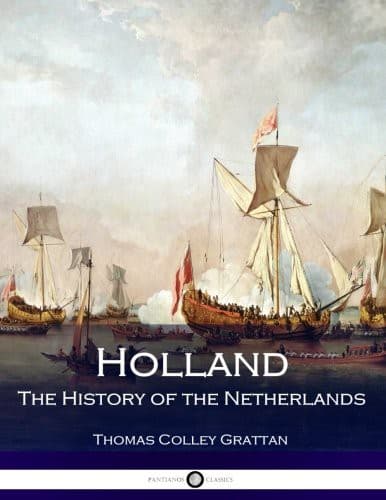
Holland: The History of the Netherlands — John Shaqi
Holland: The History of the NetherlandsGrattan, Thomas Colley
History
Holland: The History of the Netherlands
Grattan, Thomas Colley
Netherlands -- History
From this epoch we must trace the progress of a totally new and
distinct population in the Netherlands. The Batavians being
annihilated, almost without resistance, the low countries contained
only the free people of the German race. But these people did not
completely sympathize together so as to form one consolidated
nation. The Salians, and the other petty tribes of Franks, their
allies, were essentially warlike, and appeared precisely the same
as the original inhabitants of the high grounds. The Menapians
and the Frisons, on the contrary, lost nothing of their spirit
of commerce and industry. The result of this diversity was a
separation between the Franks and the Menapians. While the latter,
under the name of Armoricans, joined themselves more closely
with the people who bordered the Channel, the Frisons associated
themselves with the tribes settled on the limits of the German
Ocean, and formed with them a connection celebrated under the
title of the Saxon League. Thus was formed on all points a union
between the maritime races against the inland inhabitants; and
their mutual antipathy became more and more developed as the
decline of the Roman empire ended the former struggle between
liberty and conquest.
The Netherlands now became the earliest theatre of an entirely
new movement, the consequences of which were destined to affect
the whole world. This country was occupied toward the sea by
a people wholly maritime, excepting the narrow space between
the Rhine and the Vahal, of which the Salian Franks had become
possessed. The nature of this marshy soil, in comparison with the
sands of Westphalia, Guelders, and North Brabant, was not more
strikingly contrasted than was the character of their population.
The Franks, who had been for a while under the Roman sway, showed
a compound of the violence of savage life and the corruption
of civilized society. They were covetous and treacherous, but
made excellent soldiers; and at this epoch, which intervened
between the power of imperial Rome and that of Germany, the Frank
might be morally considered as a borderer on the frontiers of the
Middle Ages. The Saxon (and this name comprehends all the tribes
of the coast from the Rhine as far north as Denmark), uniting in
himself the distinctive qualities of German and navigator, was
moderate and sincere, but implacable in his rage. Neither of
these two races of men was excelled in point of courage; but
the number of Franks who still entered into the service of the
empire diminished the real force of this nation, and naturally
tended to disunite it. Therefore, in the subsequent shock of
people against people, the Saxons invariably gained the final
advantage.
Public-domain text, read in full here on John Shaqi.
Reviews
Reviews
No reviews yet
Be the first to share your thoughts on this work.
Join the Discussion
Join the discussion
Sign in to leave a comment or review.
Sign InorCreate an account