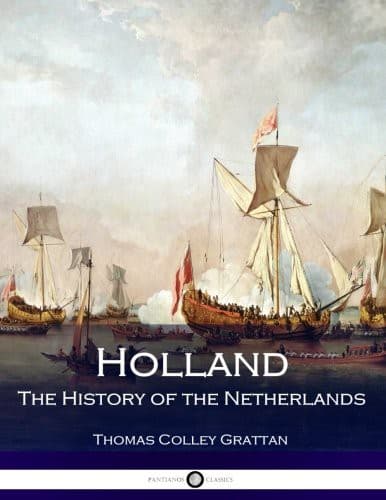
Holland: The History of the NetherlandsGrattan, Thomas Colley
History
Holland: The History of the Netherlands
Grattan, Thomas Colley
Netherlands -- History
Louis XIV., menaced by the League of Augsburg, had resolved to
strike the first blow against the allies. He invaded Germany; so
that the Dutch preparations seemed in the first instance intended
as measures of defence against the progress of the French. But
Louis's envoy at The Hague could not be long deceived. He gave
notice to his master, who in his turn warned James. But that
infatuated monarch not only doubted the intelligence, but refused
the French king's offers of assistance and co-operation. On the
21st of October, the Prince of Orange, with an army of fourteen
thousand men, and a fleet of five hundred vessels of all kinds,
set sail from Helvoetsluys; and after some delays from bad weather,
he safely landed his army in Torbay, on the 5th of November, 1688.
The desertion of James's best friends; his own consternation,
flight, seizure, and second escape; and the solemn act by which he
was deposed; were the rapid occurrences of a few weeks: and thus
the grandest revolution that England had ever seen was happily
consummated. Without entering here on legislative reasonings or
party sophisms, it is enough to record the act itself; and to
say, in reference to our more immediate subject, that without
the assistance of Holland and her glorious chief, England might
have still remained enslaved, or have had to purchase liberty
by oceans of blood. By the bill of settlement, the crown was
conveyed jointly to the Prince and Princess of Orange, the sole
administration of government to remain in the prince; and the
new sovereigns were proclaimed on the 23d of February, 1689.
The convention, which had arranged this important point, annexed
to the settlement a declaration of rights, by which the powers
of royal prerogative and the extent of popular privilege were
defined and guaranteed.
William, now become king of England, still preserved his title
of stadtholder of Holland; and presented the singular instance
of a monarchy and a republic being at the same time governed by
the same individual. But whether as a king or a citizen, William
was actuated by one grand and powerful principle, to which every
act of private administration was made subservient, although
it certainly called for no sacrifice that was not required for
the political existence of the two nations of which he was the
head. Inveterate opposition to the power of Louis XIV. was this
all-absorbing motive. A sentiment so mighty left William but
little time for inferior points of government, and everything
but that seems to have irritated and disgusted him. He was soon
again on the Continent, the chief theatre of his efforts. He
put himself in front of the confederacy which resulted from the
congress of Utrecht in 1690. He took the command of the allied
army; and till the hour of his death, he never ceased his
indefatigable course of hostility, whether in the camp or the
cabinet, at the head of the allied armies, or as the guiding
spirit of the councils which gave them force and motion.
Public-domain text, read in full here on John Shaqi.
Reviews
Reviews
No reviews yet
Be the first to share your thoughts on this work.
Elsewhere in the archive
Join the Discussion
Join the discussion
Sign in to leave a comment or review.
Sign InorCreate an account