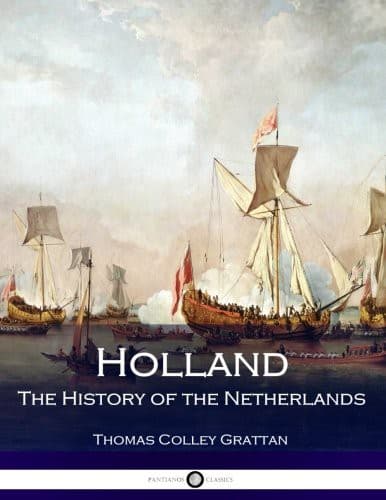
Holland: The History of the NetherlandsGrattan, Thomas Colley
History
Holland: The History of the Netherlands
Grattan, Thomas Colley
Netherlands -- History
Several campaigns were expended, and bloody combats fought, almost
all to the disadvantage of William, whose genius for war was
never seconded by that good fortune which so often decides the
fate of battles in defiance of all the calculations of talent.
But no reverse had power to shake the constancy and courage of
William. He always appeared as formidable after defeat as he
was before action. His conquerors gained little but the honor
of the day. Fleurus, Steinkerk, Herwinde, were successively the
scenes of his evil fortune, and the sources of his fame. His
retreats were master-strokes of vigilant activity and profound
combinations. Many eminent sieges took place during this war.
Among other towns, Mons and Namur were taken by the French, and
Huy by the allies; and the army of Marshal Villeroi bombarded
Brussels during three days, in August, 1695, with such fury that
the town-house, fourteen churches, and four thousand houses,
were reduced to ashes. The year following this event saw another
undecisive campaign. During the continuance of this war, the naval
transactions present no grand results. Du Bart, a celebrated
adventurer of Dunkirk, occupies the leading place in those affairs,
in which he carried on a desultory but active warfare against the
Dutch and English fleets, and generally with great success.
All the nations which had taken part in so many wars were now
becoming exhausted by the contest, but none so much so as France.
The great despot who had so long wielded the energies of that
country with such wonderful splendor and success found that his
unbounded love of dominion was gradually sapping all the real
good of his people, in chimerical schemes of universal conquest.
England, though with much resolution voting new supplies, and in
every way upholding William in his plans for the continuance of
war, was rejoiced when Louis accepted the mediation of Charles
XI., king of Sweden, and agreed to concessions which made peace
feasible. The emperor and Charles II. of Spain, were less satisfied
with those concessions; but everything was finally arranged to meet
the general views of the parties, and negotiations were opened
at Ryswyk. The death of the king of Sweden, and the minority of
his son and successor, the celebrated Charles XII., retarded
them on points of form for some time. At length, on the 20th of
September, 1697, the articles of the treaty were subscribed by
the Dutch, English, Spanish, and French ambassadors. The treaty
consisted of seventeen articles. The French king declared he
would not disturb or disquiet the king of Great Britain, whose
title he now for the first time acknowledged. Between France
and Holland were declared a general armistice, perpetual amity,
a mutual restitution of towns, a reciprocal renunciation of all
pretensions upon each other, and a treaty of commerce which was
immediately put into execution. Thus, after this long, expensive,
and sanguinary war, things were established just on the footing they
Public-domain text, read in full here on John Shaqi.
Reviews
Reviews
No reviews yet
Be the first to share your thoughts on this work.
Elsewhere in the archive
Join the Discussion
Join the discussion
Sign in to leave a comment or review.
Sign InorCreate an account