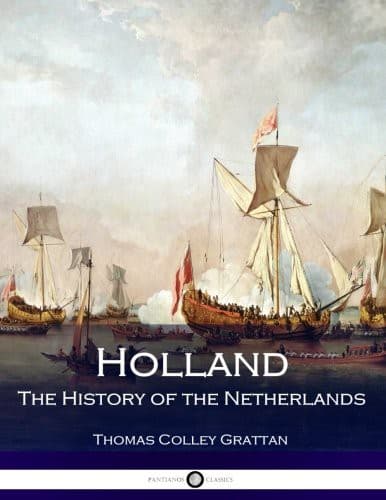
Holland: The History of the NetherlandsGrattan, Thomas Colley
History
Holland: The History of the Netherlands
Grattan, Thomas Colley
Netherlands -- History
had been by the peace of Nimeguen; and a great, though unavailable
lesson, read to the world on the futility and wickedness of those
quarrels in which the personal ambition of kings leads to the
misery of the people. Had the allies been true to each other
throughout, Louis would certainly have been reduced much lower
than he now was. His pride was humbled, and his encroachments
stopped. But the sufferings of the various countries engaged in
the war were too generally reciprocal to make its result of any
material benefit to either. The emperor held out for a while,
encouraged by the great victory gained by his general, Prince
Eugene of Savoy, over the Turks at Zenta in Hungary; but he finally
acceded to the terms offered by France; the peace, therefore,
became general, but, unfortunately for Europe, of very short
duration.
France, as if looking forward to the speedy renewal of hostilities,
still kept her armies undisbanded. Let the foresight of her
politicians have been what it might, this negative proof of it was
justified by events. The king of Spain, a weak prince, without any
direct heir for his possessions, considered himself authorized to
dispose of their succession by will. The leading powers of Europe
thought otherwise, and took this right upon themselves. Charles
died on the 1st of November, 1700, and thus put the important
question to the test. By a solemn testament he declared Philip,
duke of Anjou, second son of the dauphin, and grandson of Louis
XIV., his successor to the whole of the Spanish monarchy. Louis
immediately renounced his adherence to the treaties of partition,
executed at The Hague and in London, in 1698 and 1700, and to which
he had been a contracting party; and prepared to maintain the act
by which the last of the descendants of Charles V. bequeathed
the possessions of Spain and the Indies to the family which had
so long been the inveterate enemy and rival of his own.
The emperor Leopold, on his part, prepared to defend his claims;
and thus commenced the new war between him and France, which took
its name from the succession which formed the object of dispute.
Hostilities were commenced in Italy, where Prince Eugene, the
conqueror of the Turks, commanded for Leopold, and every day
made for himself a still more brilliant reputation. Louis sent
his grandson to Spain to take possession of the inheritance,
for which so hard a fight was yet to be maintained, with the
striking expression at parting--"My child, there are no longer
any Pyrenees!" an expression most happily unprophetic for the
future independence of Europe; for the moral force of the barrier
has long existed after the expiration of the family compact which
was meant to deprive it of its force.
Public-domain text, read in full here on John Shaqi.
Reviews
Reviews
No reviews yet
Be the first to share your thoughts on this work.
Elsewhere in the archive
Join the Discussion
Join the discussion
Sign in to leave a comment or review.
Sign InorCreate an account