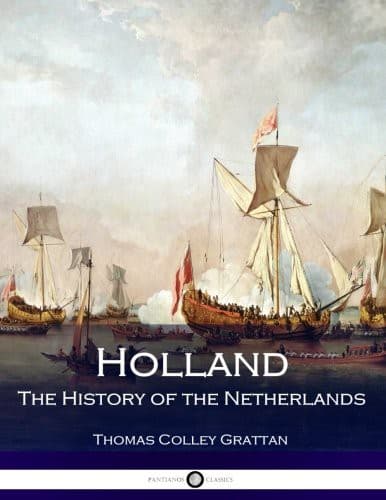
Holland: The History of the NetherlandsGrattan, Thomas Colley
History
Holland: The History of the Netherlands
Grattan, Thomas Colley
Netherlands -- History
Louis prepared to act vigorously. Among other measures, he caused
part of the Dutch army that was quartered in Luxemburg and Brabant
to be suddenly made prisoners of war, because they would not own
Philip V. as king of Spain. The states-general were dreadfully
alarmed, immediately made the required acknowledgment, and in
consequence had their soldiers released. They quickly reinforced
their garrisons, purchased supplies, solicited foreign aid, and
prepared for the worst that might happen. They wrote to King
William, professing the most inviolable attachment to England;
and he met their application by warm assurances of support and
an immediate reinforcement of three regiments.
William followed up these measures by the formation of the celebrated
treaty called the Grand Alliance, by which England, the States,
and the emperor covenanted for the support of the pretensions
of the latter to the Spanish monarchy. William was preparing,
in spite of his declining health, to take his usual lead in the
military operations now decided on, and almost all Europe was
again looking forward to his guidance, when he died on the 8th of
March, 1701, leaving his great plans to receive their execution
from still more able adepts in the art of war.
William's character has been traced by many hands. In his capacity
of king of England, it is not our province to judge him in this
place. As stadtholder of Holland, he merits unqualified praise.
Like his great ancestor William I., whom he more resembled than
any other of his race, he saved the country in a time of such
imminent peril that its abandonment seemed the only resource
left to the inhabitants, who preferred self-exile to slavery.
All his acts were certainly merged in the one overwhelming object
of a great ambition--that noble quality, which, if coupled with
the love of country, is the very essence of true heroism. William
was the last of that illustrious line which for a century and a
half had filled Europe with admiration. He never had a child;
and being himself an only one, his title as Prince of Orange
passed into another branch of the family. He left his cousin,
Prince Frison of Nassau, the stadtholder of Friesland, his sole
and universal heir, and appointed the states-general his executors.
Public-domain text, read in full here on John Shaqi.
Reviews
Reviews
No reviews yet
Be the first to share your thoughts on this work.
Elsewhere in the archive
Join the Discussion
Join the discussion
Sign in to leave a comment or review.
Sign InorCreate an account