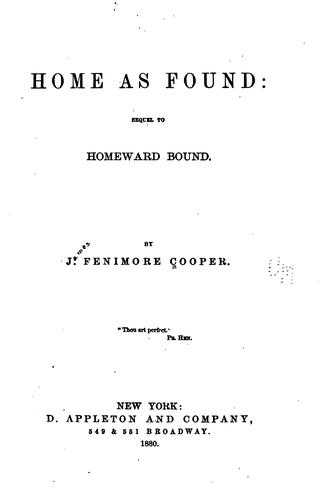
Home as Found: Sequel to "Homeward Bound"Cooper, James Fenimore
General
Home as Found: Sequel to "Homeward Bound"
Cooper, James Fenimore
United States -- Social life and customs -- Fiction
What has just been said, depends on a general and natural principle,
perhaps; but the state of society we are describing has some features
peculiar to itself. The civilization of America, even in its older
districts, which supply the emigrants to the newer regions, is
unequal; one state possessing a higher level than another. Coming as
it does, from different parts of this vast country, the population of
a new settlement, while it is singularly homogenous for the
circumstances, necessarily brings with it its local peculiarities. If
to these elements be added a sprinkling of Europeans of various
nations and conditions, the effects of the commingling, and the
temporary social struggles that follow, will occasion no surprise.
The third and last condition of society in a "new country," is that
in which the influence of the particular causes enumerated ceases,
and men and things come within the control of more general and
regular laws. The effect, of course, is to leave the community
possession of a civilization that conforms to that of the whole
region, be it higher or be it lower, and with the division into
castes that are more or less rigidly maintained, according to
circumstances.
The periods, as the astronomers call the time taken in a celestial
revolution, of the two first of these epochs in the history of a
settlement, depend very much on its advancement in wealth and in
numbers. In some places, the pastoral age, or that of good
fellowship, continues for a whole life, to the obvious retrogression
of the people, in most of the higher qualities, but to their manifest
advantage, however, in the pleasures of the time being; while, in
others, it passes away rapidly, like the buoyant animal joys, that
live their time, between fourteen and twenty.
The second period is usually of longer duration, the migratory habits
of the American people keeping society more unsettled than might
otherwise prove to be the case. It may be said never to cease
entirely until the great majority of the living generation are
natives of the region, knowing no other means of comparison than
those under which they have passed their days. Even when this is the
case, there is commonly so large an infusion of the birds of passage,
men who are adventurers in quest of advancement, and who live without
the charities of a neighbourhood, as they may be said almost to live
without a home, that there is to be found, for a long time, a middle
state of society, during which it may well be questioned whether a
community belongs to the second or to the third of the periods named.
Public-domain text, read in full here on John Shaqi.
Reviews
Reviews
No reviews yet
Be the first to share your thoughts on this work.
Elsewhere in the archive
Join the Discussion
Join the discussion
Sign in to leave a comment or review.
Sign InorCreate an account