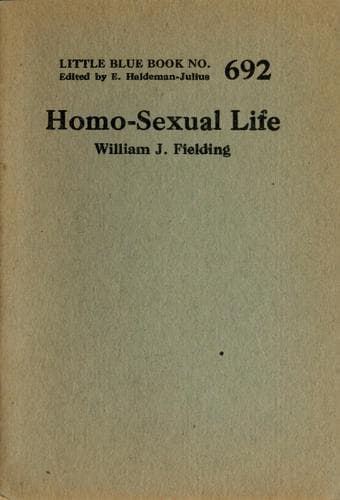
Homo-sexual lifeFielding, William J. (William John)
Science
Homo-sexual life
Fielding, William J. (William John)
Homosexuality; Sex (Psychology)
There are some human beings--_variants_--who possess hermaphrodite
characteristics, usually combining the more or less completely
developed organs of one sex with the rudimentary organs of the opposite
sex.
These hermaphrodite characters are not without their
significance--namely, the innate bisexuality of man. While in the
normal person, the attributes of one sex are dominant, there are always
present in latent form some evidences of the opposite sex. This is no
new discovery. In fact the concept of bisexuality is very ancient.
Traces of it are to be found in Chinese mythology. The classical Greek
mind seems to have had a particular interest in speculating about it.
The mythical personification of bisexuality in the Hermaphroditos, the
narrative of Aristophanes in the Platonic dialogue, and at a later
period the suggestion of a Gnostic sect (Theophites) that primitive
man was a “man-woman,” are all based on this presentiment. The first
divinities were always bisexual, being either women with a penis or men
with a female breast.
WHAT BIOLOGY TEACHES US.
Lower down in the biological scale--in fact, at the very bottom--we
find the _amoeba_, which represents an auto-sexual, or more accurately,
a mono-sexual, form. It has all the potentialities for reproduction
within itself. By the process of division, first of its nucleus, and
then its whole self, it becomes two new individuals.
A little further up the evolutionary path, we find the _paramoecium_.
At one stage of its career it will divide its nucleus first, and then
itself (an autosexual act) similar to the _amoeba_. At another stage it
will engage in an elementary sexual act by coming ventrally together
with another _paramoecium_, exchange one-half of its nucleus for
half the nucleus of the other _paramoecium_, through the mouth, and
this process is followed by other nuclear changes, and finally each
_paramoecium_ divides itself into two new entities.
There is no apparent difference between these primitive little
animals. They have no male and female organs, but it is a plausible
assumption that the nuclei of each one contains a “male” and “female”
portion--something unknown but necessary to procreation. In this
instance we have the beginning of bisexuality; but autosexuality is
still an essential factor in reproduction.
Somewhat higher up the scale we come across the _hydra_, a
multicellular animal. Here, also, autosexuality plays a prominent role.
The _hydra_ can, without the aid of another, “bud off” a new living
_hydra_. Bisexuality is evidenced, however, in the presence of male
and female cells which form in the single _hydra_. These unite with
one another to produce a new individual in true bisexual manner. In a
sense this creature is a combination of the autosexual, bisexual and
hermaphrodite.
Public-domain text, read in full here on John Shaqi.
Reviews
Reviews
No reviews yet
Be the first to share your thoughts on this work.
Join the Discussion
Join the discussion
Sign in to leave a comment or review.
Sign InorCreate an account